Ch. 9 - Alkenes II: Oxidation and Reduction
Mullins - Organic Chemistry: A Learner Centered Approach 1st Edition
Mullins1st EditionOrganic Chemistry: A Learner Centered ApproachISBN: 9780137566471Not the one you use?Change textbook
Chapter 8, Problem 17

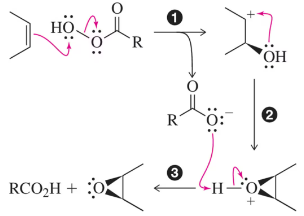
Evidence for the concertedness of epoxide formation comes from the stereospecificity of the reaction. If step 2 of a hypothetical stepwise mechanism were slow enough to make the reaction non-concerted, how would the product distribution change?

Verified step by step guidance
1
Step 1: Understand the concept of stereospecificity in a concerted reaction. A concerted reaction occurs in a single step where bond-breaking and bond-forming happen simultaneously. This leads to a stereospecific outcome, meaning the stereochemistry of the reactants directly determines the stereochemistry of the products.
Step 2: Analyze the provided mechanism. The image shows a reaction involving epoxide formation. In a concerted mechanism, the stereochemistry of the starting material is preserved in the product due to the simultaneous nature of bond changes.
Step 3: Consider the hypothetical stepwise mechanism. If step 2 of the mechanism were slow enough to make the reaction non-concerted, the intermediate formed would have time to rotate or adopt different conformations. This would lead to a loss of stereospecificity, resulting in a mixture of stereoisomers in the product.
Step 4: Relate this to product distribution. In a non-concerted reaction, the product distribution would no longer be stereospecific. Instead, you would observe a racemic mixture or a mix of diastereomers, depending on the nature of the intermediate and the reaction conditions.
Step 5: Conclude the impact of concertedness on stereospecificity. The stereospecificity of the reaction is evidence for its concerted nature. If the reaction were non-concerted, the stereochemistry of the product would not directly correlate with the stereochemistry of the reactant, leading to a broader product distribution.

Verified video answer for a similar problem:

This video solution was recommended by our tutors as helpful for the problem above.
Was this helpful?

Key Concepts

Here are the essential concepts you must grasp in order to answer the question correctly.

Concerted Mechanism

A concerted mechanism refers to a reaction pathway where bond formation and breaking occur simultaneously in a single step, without intermediates. In the context of epoxide formation, this means that the stereochemistry of the reactants is preserved in the products, leading to stereospecific outcomes. Understanding this concept is crucial for analyzing how changes in reaction conditions can affect product distribution.
Recommended video:
Guided course
04:32
General Mechanism

Stereospecificity

Stereospecificity is the property of a reaction where the configuration of the reactant determines the configuration of the product. In the case of epoxide formation, if the reaction is stereospecific, the spatial arrangement of substituents in the starting material will directly influence the stereochemistry of the epoxide formed. This concept is essential for predicting how alterations in the reaction mechanism can lead to different product distributions.
Recommended video:
Guided course
15:39
Box-Out Method and Full-Mechanism

Stepwise Mechanism

A stepwise mechanism involves a series of discrete steps, often including intermediates, where each step can have different rates. If the second step of a hypothetical mechanism is slow, it can lead to a non-concerted reaction, allowing for the possibility of rearrangements or different pathways that can alter the final product distribution. Recognizing the implications of a stepwise mechanism is vital for understanding how reaction conditions can influence outcomes.
Recommended video:
Guided course
04:32
General Mechanism