Ch. 9 - Alkenes II: Oxidation and Reduction
Mullins - Organic Chemistry: A Learner Centered Approach 1st Edition
Mullins1st EditionOrganic Chemistry: A Learner Centered ApproachISBN: 9780137566471Not the one you use?Change textbook
Chapter 8, Problem 44c

Determine whether the following reactions are redox reactions. If they are, identify whether the molecule has been oxidized or reduced.
(c) Chemical reaction diagram showing the conversion of an alkene to an alcohol using sulfuric acid and methanol.

Verified step by step guidance
1
Identify the reactants and products in the given reaction. The reactant is an epoxide, and the product is an alcohol with an ether group.
Determine the type of reaction. The reaction involves the opening of an epoxide ring in the presence of an acid (H2SO4) and methanol (CH3OH), which suggests an acid-catalyzed ring-opening reaction.
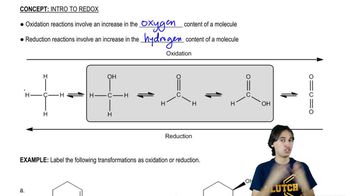
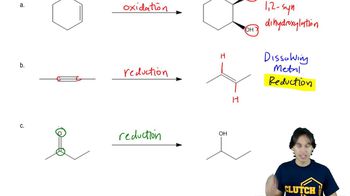
Analyze the changes in oxidation states. In organic chemistry, oxidation involves an increase in the number of bonds to oxygen or a decrease in the number of bonds to hydrogen, while reduction involves the opposite.
Examine the structure of the reactant and product. The epoxide ring is opened, and a methoxy group (OCH3) and a hydroxyl group (OH) are added to the carbon atoms of the former epoxide.
Conclude whether the reaction is a redox reaction. Since there is no change in the oxidation state of the carbon atoms involved (no net gain or loss of electrons), this reaction is not a redox reaction.

Verified video answer for a similar problem:

This video solution was recommended by our tutors as helpful for the problem above.
Was this helpful?

Key Concepts

Here are the essential concepts you must grasp in order to answer the question correctly.

Redox Reactions

Redox reactions involve the transfer of electrons between two species, resulting in changes in oxidation states. Oxidation refers to the loss of electrons, while reduction refers to the gain of electrons. In organic chemistry, redox reactions often involve changes in the number of bonds to oxygen or hydrogen, such as the conversion of alcohols to ketones or alkenes to alcohols.
Recommended video:
Guided course
06:02
General Features of Redox

Oxidation and Reduction in Organic Chemistry

In organic chemistry, oxidation typically involves the increase in the number of carbon-oxygen bonds or the decrease in carbon-hydrogen bonds, while reduction involves the opposite. For example, converting an alkene to an alcohol involves the addition of an OH group, which can be seen as a reduction if it results in more C-H bonds or fewer C-O bonds.
Recommended video:
Guided course
00:54
Distinguishing between Oxidation and Reduction

Acid-Catalyzed Hydration of Alkenes

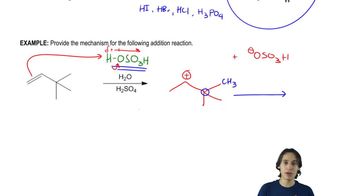
Acid-catalyzed hydration is a reaction where an alkene is converted into an alcohol using an acid catalyst, such as sulfuric acid, and water or an alcohol. The reaction proceeds through the formation of a carbocation intermediate, followed by nucleophilic attack by water or an alcohol, resulting in the addition of an OH group to the alkene, forming an alcohol.
Recommended video:
Guided course
06:34
Acid-catalyzed hydration mechanism