Ch. 9 - Alkenes II: Oxidation and Reduction
Mullins - Organic Chemistry: A Learner Centered Approach 1st Edition
Mullins1st EditionOrganic Chemistry: A Learner Centered ApproachISBN: 9780137566471Not the one you use?Change textbook
Chapter 8, Problem 43c

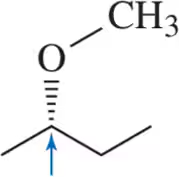
Calculate the oxidation number for the indicated carbons.
(c) Chemical structure showing an ether group with a blue arrow pointing to a carbon atom for oxidation number calculation.

Verified step by step guidance
1
Identify the carbon atom for which you need to calculate the oxidation number. In organic molecules, this is often indicated by a specific label or context within the problem.
Determine the number of bonds the carbon atom forms with atoms that are more electronegative than carbon, such as oxygen, nitrogen, or halogens. Each bond to a more electronegative atom increases the oxidation state by +1.
Determine the number of bonds the carbon atom forms with atoms that are less electronegative than carbon, such as hydrogen. Each bond to a less electronegative atom decreases the oxidation state by -1.
Consider any bonds the carbon atom forms with other carbon atoms. These typically do not affect the oxidation state, as the electronegativity is the same.
Sum the contributions from each bond to determine the oxidation number of the carbon atom. Remember that the oxidation number is a formalism and may not represent the actual charge on the atom.

Verified video answer for a similar problem:

This video solution was recommended by our tutors as helpful for the problem above.
Was this helpful?

Key Concepts

Here are the essential concepts you must grasp in order to answer the question correctly.

Oxidation Number

The oxidation number is a theoretical charge assigned to an atom in a molecule, representing the number of electrons lost or gained by the atom. It helps in determining the electron distribution in compounds and is crucial for understanding redox reactions. In organic chemistry, it is often used to track changes in electron density around carbon atoms.
Recommended video:
Guided course
03:40
Strong oxidizing agents

Rules for Assigning Oxidation Numbers

Assigning oxidation numbers involves specific rules: elements in their natural state have an oxidation number of zero, the sum of oxidation numbers in a neutral compound is zero, and in ions, it equals the ion's charge. For carbon, the oxidation number is determined by considering its bonds with more or less electronegative atoms, such as hydrogen or oxygen.
Recommended video:
Guided course
03:54
The 18 and 16 Electron Rule

Electronegativity and Bond Polarity

Electronegativity is the tendency of an atom to attract electrons in a bond. In organic molecules, carbon's oxidation state is influenced by its bonding with atoms of different electronegativities. For example, carbon bonded to more electronegative atoms like oxygen is considered oxidized, while bonds with less electronegative atoms like hydrogen reduce its oxidation state.
Recommended video:
Guided course
1:47
Electronegativity