
Ch. 9 - Alkenes II: Oxidation and Reduction
Mullins - Organic Chemistry: A Learner Centered Approach 1st Edition
Mullins1st EditionOrganic Chemistry: A Learner Centered ApproachISBN: 9780137566471Not the one you use?Change textbook
Chapter 8, Problem 59h

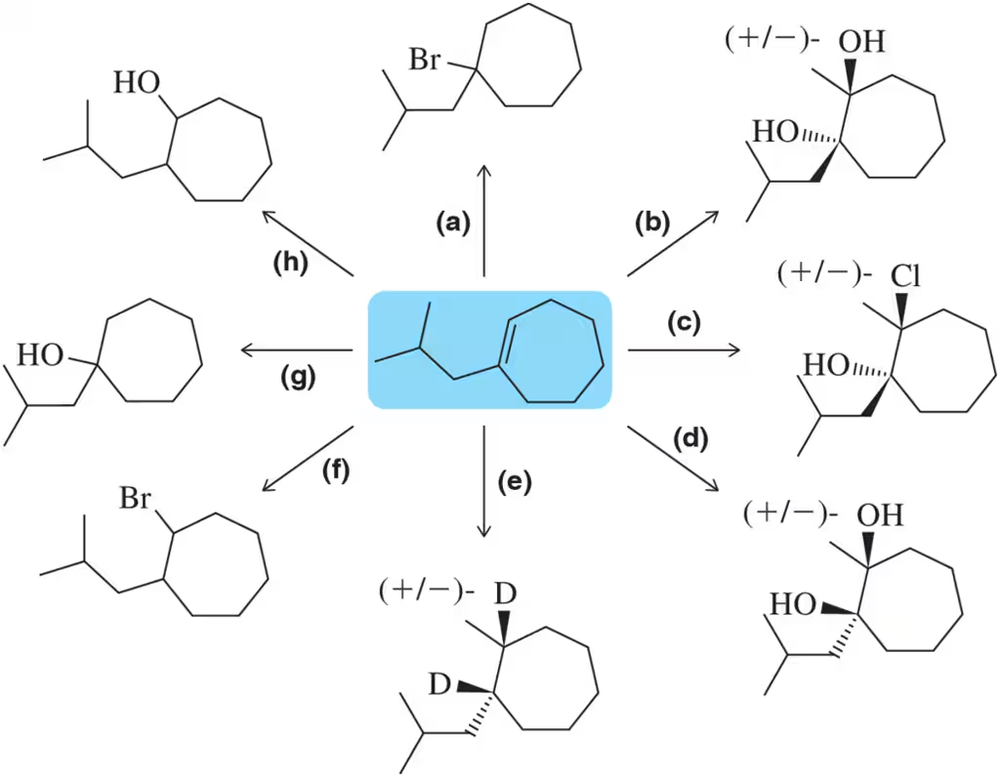
At the beginning of Chapter 9, we stated that after finishing Chapters 8 and 9, we would have the ability to make a large variety of functional groups using related reactions. Show the reagent(s) necessary to convert 1-isobutylcyclohexene into the following molecules.
(h) Diagram showing the conversion of 1-isobutylcyclohexene into various products using different reagents.

Verified step by step guidance
1
Analyze the structure of 1-isobutylcyclohexene. It contains a cyclohexene ring with a double bond and an isobutyl group attached to the ring. Identify the functional group transformation required for the target molecule.
Determine the type of reaction needed to achieve the transformation. For example, if the target molecule involves the addition of a functional group to the double bond, consider reactions such as hydroboration-oxidation, halogenation, or epoxidation.
Select the appropriate reagent(s) for the reaction. For instance, if the target molecule requires the formation of an alcohol, hydroboration-oxidation can be used with reagents such as BH₃·THF followed by H₂O₂/NaOH.
Consider the regioselectivity and stereoselectivity of the reaction. For example, hydroboration-oxidation adds an -OH group to the less substituted carbon of the double bond (anti-Markovnikov addition) and occurs with syn stereochemistry.
Write the reaction mechanism to confirm the transformation. Show how the reagent(s) interact with 1-isobutylcyclohexene to produce the desired product, ensuring all intermediates and stereochemical outcomes are accounted for.

Verified video answer for a similar problem:

This video solution was recommended by our tutors as helpful for the problem above.
Video duration:
2m
Was this helpful?

Key Concepts

Here are the essential concepts you must grasp in order to answer the question correctly.

Functional Groups

Functional groups are specific groups of atoms within molecules that are responsible for the characteristic chemical reactions of those molecules. Understanding functional groups is essential in organic chemistry as they dictate the reactivity and properties of compounds. For example, alkenes, alcohols, and carboxylic acids each have distinct functional groups that influence how they interact with other substances.
Recommended video:
Guided course
02:36
Identifying Functional Groups

Reagents in Organic Reactions

Reagents are substances that are added to a system to bring about a chemical reaction or to see if a reaction occurs. In organic chemistry, different reagents are used to facilitate transformations of functional groups, such as oxidation, reduction, or substitution. Knowing the appropriate reagents for specific transformations is crucial for synthesizing desired products from starting materials.
Recommended video:
Guided course
02:17
Identifying organic molecules

Reaction Mechanisms

Reaction mechanisms describe the step-by-step process by which reactants are converted into products. Understanding these mechanisms helps predict the outcome of reactions and the conditions required for them to occur. For instance, knowing whether a reaction proceeds via an electrophilic addition or a nucleophilic substitution can guide the choice of reagents and conditions needed to achieve the desired transformation.
Recommended video:
Guided course
02:16
Heck Reaction Mechanism
Related Practice
Textbook Question

At the beginning of Chapter 9, we stated that after finishing Chapters 8 and 9, we would have the ability to make a large variety of functional groups using related reactions. Show the reagent(s) necessary to convert 1-isobutylcyclohexene into the following molecules.

(e)

1
views
Textbook Question

At the beginning of Chapter 9, we stated that after finishing Chapters 8 and 9, we would have the ability to make a large variety of functional groups using related reactions. Show the reagent(s) necessary to convert 1-isobutylcyclohexene into the following molecules.

(f)

Textbook Question

Retrosynthetic analysis is the process of working backward to develop the synthesis of a new compound. In Chapter 10, we begin developing multistep syntheses in this manner. For now, try to work backward a single step by suggesting an alkene and a reagent that would give products (a)–(i). [Your answers should not include alkenes that undergo rearrangement to give the desired products.]

(a)

2
views
Textbook Question

At the beginning of Chapter 9, we stated that after finishing Chapters 8 and 9, we would have the ability to make a large variety of functional groups using related reactions. Show the reagent(s) necessary to convert 1-isobutylcyclohexene into the following molecules.

(g)

1
views
Textbook Question

Retrosynthetic analysis is the process of working backward to develop the synthesis of a new compound. In Chapter 10, we begin developing multistep syntheses in this manner. For now, try to work backward a single step by suggesting an alkene and a reagent that would give products (a)–(i). [Your answers should not include alkenes that undergo rearrangement to give the desired products.]

(d)

2
views
Textbook Question

Retrosynthetic analysis is the process of working backward to develop the synthesis of a new compound. In Chapter 10, we begin developing multistep syntheses in this manner. For now, try to work backward a single step by suggesting an alkene and a reagent that would give products (a)–(i). [Your answers should not include alkenes that undergo rearrangement to give the desired products.]


(b)

1
views