Ch. 8 - Alkenes I: Properties and Electrophilic Additions
Mullins - Organic Chemistry: A Learner Centered Approach 1st Edition
Mullins1st EditionOrganic Chemistry: A Learner Centered ApproachISBN: 9780137566471Not the one you use?Change textbook
Chapter 7, Problem 45e

Which of the following carbocations would you expect to rearrange? If you expect rearrangement, draw the carbocation you expect to form and the mechanism by which it will form.
(e) Diagram of a carbocation with a positive charge and a proposed rearrangement mechanism.

Verified step by step guidance
1
Analyze the given carbocation structure: The carbocation is attached to a cyclobutane ring. Cyclobutane is a strained ring system due to its small size and bond angles deviating from the ideal tetrahedral angle (109.5°). This strain makes the system prone to rearrangement.
Consider the stability of the carbocation: Carbocations are stabilized by hyperconjugation and resonance. A rearrangement may occur if it leads to a more stable carbocation, such as a tertiary carbocation or one with resonance stabilization.
Identify possible rearrangement mechanisms: In this case, a ring expansion is likely. Cyclobutane can expand to form a cyclopentane ring, relieving ring strain and potentially forming a more stable carbocation.
Describe the mechanism: The rearrangement involves a hydride or alkyl shift. A bond from the cyclobutane ring migrates to the positively charged carbon, resulting in the formation of a cyclopentane ring with the positive charge relocated to a new position.
Draw the expected product: The rearranged carbocation will have a cyclopentane ring with the positive charge on a carbon that is more stable due to reduced ring strain and potentially increased substitution (e.g., tertiary carbocation).

Verified video answer for a similar problem:

This video solution was recommended by our tutors as helpful for the problem above.
Was this helpful?

Key Concepts

Here are the essential concepts you must grasp in order to answer the question correctly.

Carbocation Stability

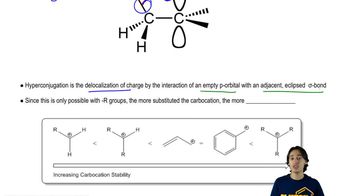
Carbocations are positively charged carbon species that can rearrange to form more stable structures. The stability of a carbocation is influenced by the degree of substitution: tertiary carbocations are more stable than secondary, which are more stable than primary. This stability is due to hyperconjugation and the inductive effect of alkyl groups, which help to disperse the positive charge.
Recommended video:
Guided course
05:58
Determining Carbocation Stability

Carbocation Rearrangement

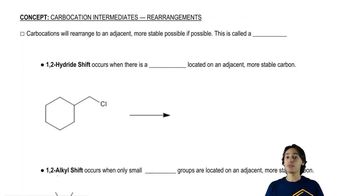
Carbocation rearrangement occurs when a carbocation shifts to a more stable form, often through hydride or alkyl shifts. This process is driven by the desire to achieve a lower energy state. For example, a primary carbocation may rearrange to a more stable secondary or tertiary carbocation, which can significantly affect the outcome of a reaction.
Recommended video:
Guided course
00:47
Understanding why carbocations shift.

Mechanism of Rearrangement

The mechanism of carbocation rearrangement typically involves the migration of a hydrogen atom or an alkyl group to the positively charged carbon. This process can be illustrated through curved arrows in reaction mechanisms, showing the movement of electrons. Understanding this mechanism is crucial for predicting the products of reactions involving carbocations and their rearrangements.
Recommended video:
Guided course
06:08
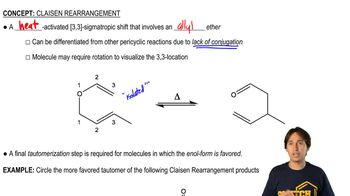
Definition of Claisen Rearrangement