Ch. 8 - Alkenes I: Properties and Electrophilic Additions
Mullins - Organic Chemistry: A Learner Centered Approach 1st Edition
Mullins1st EditionOrganic Chemistry: A Learner Centered ApproachISBN: 9780137566471Not the one you use?Change textbook
Chapter 7, Problem 62b

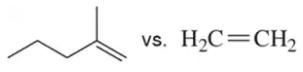
Which of the following alkenes would you expect to react fastest with HBr in each pair?
(b)

Verified step by step guidance
1
Identify the alkenes in the pair: The first alkene is 2-methyl-2-butene, and the second alkene is ethene (H₂C=CH₂).
Understand the mechanism of the reaction: The reaction of alkenes with HBr is an electrophilic addition reaction where the alkene's π bond attacks the electrophile (H⁺ from HBr), forming a carbocation intermediate.
Consider the stability of the carbocation intermediate: More substituted carbocations are more stable due to hyperconjugation and inductive effects. Tertiary carbocations are more stable than secondary, which are more stable than primary.
Analyze the structure of each alkene: 2-methyl-2-butene can form a tertiary carbocation upon reaction with HBr, while ethene can only form a primary carbocation.
Predict the reactivity: Since 2-methyl-2-butene forms a more stable tertiary carbocation, it will react faster with HBr compared to ethene, which forms a less stable primary carbocation.

Verified video answer for a similar problem:

This video solution was recommended by our tutors as helpful for the problem above.
Video duration:
2m
Was this helpful?

Key Concepts

Here are the essential concepts you must grasp in order to answer the question correctly.

Electrophilic Addition

Electrophilic addition is a fundamental reaction mechanism in organic chemistry where an electrophile reacts with a nucleophile, typically involving alkenes. In the case of alkenes reacting with HBr, the double bond acts as a nucleophile, attacking the electrophilic hydrogen atom of HBr. This process leads to the formation of a carbocation intermediate, which is crucial for determining the reaction rate and product distribution.
Recommended video:
Guided course
09:23
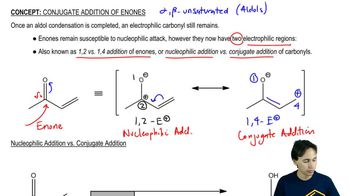
1,2 vs 1,4 Addition

Carbocation Stability

Carbocation stability is a key factor influencing the rate of reaction in electrophilic addition. Carbocations can be classified based on their stability: tertiary > secondary > primary. The more stable the carbocation formed during the reaction, the faster the reaction will proceed. Therefore, when comparing alkenes, the one that can form a more stable carbocation will react more quickly with HBr.
Recommended video:
Guided course
05:58
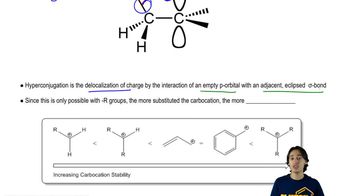
Determining Carbocation Stability

Markovnikov's Rule

Markovnikov's Rule states that in the addition of HX (like HBr) to an alkene, the hydrogen atom will attach to the carbon with the greater number of hydrogen atoms already attached. This rule helps predict the major product of the reaction and is closely related to carbocation stability. Understanding this rule is essential for determining which alkene will react faster, as it guides the formation of the more stable carbocation.
Recommended video:
Guided course
03:54
The 18 and 16 Electron Rule