Unlike hydroboration–oxidation, the addition of H2O catalyzed by H3O+ is not stereospecific. Thinking carefully about the mechanism of the reaction, give two reasons why.
Ch. 8 - Alkenes I: Properties and Electrophilic Additions

Mullins1st EditionOrganic Chemistry: A Learner Centered ApproachISBN: 9780137566471Not the one you use?Change textbook
Chapter 7, Problem 57
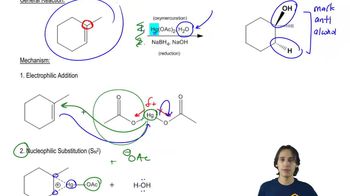
The first step of oxymercuration–reduction is stereospecific, and yet this fact wasn't emphasized in that discussion. Show the stereospecificity of the first step for the following alkene and then explain why the stereospecificity becomes unimportant after the second step.

Verified step by step guidance1
Identify the alkene structure involved in the oxymercuration-reduction reaction. The alkene will undergo an addition reaction with mercuric acetate (Hg(OAc)₂) in the presence of water.
Understand that the first step of oxymercuration involves the formation of a mercurinium ion intermediate. This step is stereospecific because the addition of the mercuric acetate occurs from one side of the double bond, leading to a specific stereochemistry in the intermediate.
Illustrate the formation of the mercurinium ion. The alkene's π electrons attack the mercury atom, forming a cyclic mercurinium ion. This intermediate is crucial as it dictates the stereochemistry of the subsequent nucleophilic attack.
Explain that the stereospecificity becomes unimportant after the second step, which is the reduction step. In this step, sodium borohydride (NaBH₄) is used to reduce the mercurinium ion, replacing the mercury with a hydrogen atom. This reduction step is not stereospecific, as it can occur from either side of the intermediate, leading to a mixture of stereoisomers.
Conclude by emphasizing that while the first step is stereospecific, the overall reaction results in a racemic mixture due to the non-stereospecific nature of the reduction step. This is why the stereospecificity of the first step is not emphasized in the overall reaction outcome.

Verified video answer for a similar problem:
This video solution was recommended by our tutors as helpful for the problem above.
Video duration:
14mWas this helpful?
Key Concepts
Here are the essential concepts you must grasp in order to answer the question correctly.
Oxymercuration-Reduction Mechanism
Oxymercuration-reduction is a two-step reaction used to convert alkenes into alcohols. The first step involves the addition of mercuric acetate to the alkene, forming a mercurinium ion intermediate. This step is stereospecific, meaning it occurs with a specific spatial arrangement, often leading to anti-addition. The second step involves reduction with sodium borohydride, which replaces the mercury with a hydrogen atom, completing the transformation to an alcohol.
Recommended video:
Guided course
Acid-catalyzed oxymercuration-reduction mechanism
Stereospecificity in Chemical Reactions
Stereospecificity refers to a reaction where a particular stereoisomer of a reactant leads to a specific stereoisomer of the product. In the context of oxymercuration, the formation of the mercurinium ion intermediate is stereospecific, as it dictates the spatial arrangement of atoms in the product. This specificity is crucial in the first step but becomes less relevant in the second step due to the reduction process, which does not alter the stereochemistry established earlier.
Recommended video:
Chemical Reactions of Phosphate Anhydrides Concept 1
Importance of Stereochemistry in Reduction
During the reduction step of oxymercuration-reduction, the stereochemistry established in the first step becomes unimportant because the reduction with sodium borohydride is not stereospecific. This step involves the replacement of the mercury atom with a hydrogen atom, which does not affect the spatial arrangement of the remaining atoms. Thus, the stereochemical outcome of the first step does not influence the final product's stereochemistry.
Recommended video:
Polymer Stereochemistry Concept 1
Related Practice
Textbook Question
1
views
Textbook Question
Suggest an alkene to undergo hydroboration–oxidation (1. BH3 2. NaOH, H2O2) to give exclusively the alcohols shown. Pay close attention to the relative (but not absolute) stereochemical outcome.
(d)
1
views
Textbook Question
Calculate the index of hydrogen deficiency for the following molecular formulas and structures.
(c)
2
views
Textbook Question
Predict the major product(s) of the following elimination reactions, paying close attention to the stereochemical outcome of the reactions.
(e)
1
views
Textbook Question
Calculate the index of hydrogen deficiency for the following molecular formulas and structures.
(a)
2
views
Textbook Question
Calculate the index of hydrogen deficiency for the following molecular formulas and structures.
(b)
1
views