Ch. 8 - Alkenes I: Properties and Electrophilic Additions
Mullins - Organic Chemistry: A Learner Centered Approach 1st Edition
Mullins1st EditionOrganic Chemistry: A Learner Centered ApproachISBN: 9780137566471Not the one you use?Change textbook
Chapter 7, Problem 61b(iii)

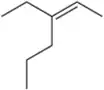
Predict the product(s) that would result when the alkenes shown here are allowed to react under the following conditions: (iii) HBr, H2O2
(b) Structural representation of alkenes for predicting products of anti-Markovnikov addition of HBr with H2O2.

Verified step by step guidance
1
Identify the type of reaction: The reaction involves an alkene reacting with HBr in the presence of H₂O₂. This is a free-radical addition reaction, which follows the anti-Markovnikov rule due to the presence of H₂O₂ (peroxide).
Understand the anti-Markovnikov rule: In the presence of peroxides, the bromine atom (Br) will add to the less substituted carbon of the double bond, while the hydrogen atom (H) will add to the more substituted carbon. This is the opposite of the Markovnikov rule.
Initiate the reaction mechanism: The reaction begins with the homolytic cleavage of the peroxide bond (ROOR) to generate two alkoxy radicals. These radicals then react with HBr to form a bromine radical (Br•).
Propagate the reaction: The bromine radical (Br•) reacts with the alkene, breaking the π-bond and forming a new carbon-bromine bond at the less substituted carbon. This generates a carbon-centered radical on the more substituted carbon.
Complete the reaction: The carbon-centered radical reacts with another molecule of HBr, abstracting a hydrogen atom to form the final product. The product will have the bromine atom attached to the less substituted carbon of the original double bond, consistent with the anti-Markovnikov addition.

Verified video answer for a similar problem:

This video solution was recommended by our tutors as helpful for the problem above.
Was this helpful?

Key Concepts

Here are the essential concepts you must grasp in order to answer the question correctly.

Electrophilic Addition

Electrophilic addition is a fundamental reaction mechanism in organic chemistry where an electrophile reacts with a nucleophile, typically involving alkenes. In the presence of HBr, the double bond of the alkene acts as a nucleophile, attacking the electrophilic hydrogen atom, leading to the formation of a carbocation intermediate. This process is crucial for predicting the products of reactions involving alkenes.
Recommended video:
Guided course
09:23
1,2 vs 1,4 Addition

Anti-Markovnikov's Rule

Anti-Markovnikov's Rule states that in the addition of HX to alkenes, the hydrogen atom will add to the less substituted carbon atom of the double bond when a peroxide (like H₂O₂) is present. This contrasts with Markovnikov's Rule, where the hydrogen would add to the more substituted carbon. Understanding this rule is essential for predicting the correct product distribution in reactions involving HBr and peroxides.
Recommended video:
Guided course
03:19
The Anti-Coplanar Requirement

Radical Mechanism

The radical mechanism involves the formation of free radicals during a chemical reaction, which can lead to different product outcomes compared to ionic mechanisms. In the presence of H₂O₂, the reaction proceeds via a radical pathway, generating bromine radicals that add to the alkene. This mechanism is key to understanding how the presence of peroxides alters the typical electrophilic addition reactions of alkenes.
Recommended video:
Guided course
03:28
The mechanism of Radical Polymerization.