
Ch. 8 - Alkenes I: Properties and Electrophilic Additions
Mullins - Organic Chemistry: A Learner Centered Approach 1st Edition
Mullins1st EditionOrganic Chemistry: A Learner Centered ApproachISBN: 9780137566471Not the one you use?Change textbook
Chapter 7, Problem 76a

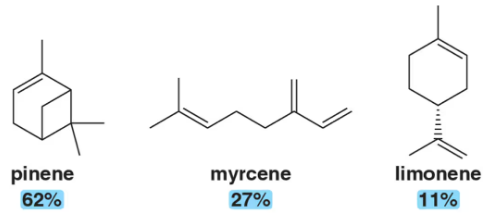
North American termite soldiers, when encountering enemy insects, contract their mandibular muscles, expelling a mixture of chemicals that essentially trap their enemies in a glue-like substance. This weapon, built into the face of the termite, is called the fontanellar gun. It releases a mixture of pinene (62%), myrcene (27%), and limonene (11%). pinene myrcene limonene 62% 27% 11%

(a) Identify the isoprene units in pinene, myrcene, and limonene.

Verified step by step guidance
1
Step 1: Recall the structure of an isoprene unit. An isoprene unit is a five-carbon building block with the molecular formula C₅H₈. It consists of a branched chain with two double bonds, typically represented as CH₂=C(CH₃)-CH=CH₂.
Step 2: Analyze the structure of pinene. Pinene is a bicyclic monoterpene with the molecular formula C₁₀H₁₆. Monoterpenes are composed of two isoprene units. Identify the two isoprene units within the pinene structure by locating the repeating C₅H₈ patterns.
Step 3: Examine the structure of myrcene. Myrcene is an acyclic monoterpene with the molecular formula C₁₀H₁₆. It contains two isoprene units connected in a linear fashion. Identify the two isoprene units by observing the arrangement of double bonds and carbon atoms.
Step 4: Investigate the structure of limonene. Limonene is a cyclic monoterpene with the molecular formula C₁₀H₁₆. Like pinene and myrcene, it is composed of two isoprene units. Identify the isoprene units by analyzing the cyclic structure and locating the C₅H₈ patterns.
Step 5: Summarize your findings. For each compound (pinene, myrcene, and limonene), clearly indicate the two isoprene units and describe how they are connected or arranged within the molecule.

Verified video answer for a similar problem:

This video solution was recommended by our tutors as helpful for the problem above.
Video duration:
7m
Was this helpful?

Key Concepts

Here are the essential concepts you must grasp in order to answer the question correctly.

Isoprene Units

Isoprene units are the fundamental building blocks of terpenes and terpenoids, consisting of a five-carbon structure (C5H8). These units can be linked together in various ways to form larger molecules. Understanding how isoprene units combine is essential for analyzing the structure of compounds like pinene, myrcene, and limonene, which are all derived from isoprene.
Recommended video:
1:39
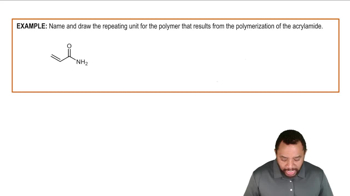
Introduction to Polymers Example 1

Terpene Structure

Terpenes are a large class of organic compounds produced by various plants, particularly conifers. They are characterized by their distinct structures, which are often formed from multiple isoprene units. Pinene, myrcene, and limonene are examples of monoterpenes, which consist of two isoprene units, and their specific arrangements contribute to their unique properties and functions.
Recommended video:
Guided course
03:04
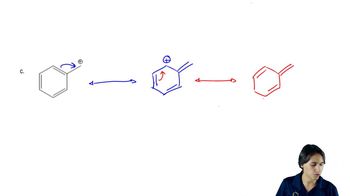
Drawing Resonance Structures

Chemical Composition and Percentages

The chemical composition and percentages of components in a mixture provide insight into the relative abundance of each compound. In the case of the fontanellar gun, the percentages of pinene, myrcene, and limonene indicate their roles in the chemical defense mechanism of termites. Understanding these proportions is crucial for identifying the isoprene units and their contributions to the overall chemical structure.
Recommended video:
Guided course
03:23
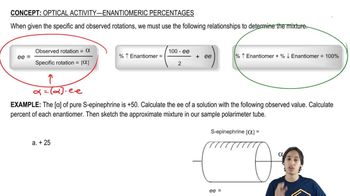
How to solve for the percentage of each enantiomer.
Related Practice
Textbook Question

In light of your answer to Assessment 8.73, predict the product of the following oxymercuration–reduction reactions, each of which results in a single product. [Don't worry about the absolute stereochemistry, though these reactions are also stereoselective.]

(b) This reaction sequence was used in the synthesis of (+) -lineatin, a monoterpene aggregation pheromone from the female ambrosia beetle Trypodendron lineatum (Org. Lett. 2004, 6, 1449–1452).

1
views
Textbook Question

In light of your answer to Assessment 8.73, predict the product of the following oxymercuration–reduction reactions, each of which results in a single product. [Don't worry about the absolute stereochemistry, though these reactions are also stereoselective.]

(c) Oxymercuration–reduction was used in the stereoselective synthesis of the macrolactone core of neopeltolide, a marine macrolide isolated from a Caribbean sponge that has potent anticancer activity (Org. Lett. 2012, 14, 2346–2349).

2
views
Textbook Question

The acid-catalyzed hydration we learned here in Chapter 8 is reversible.

(a) Propose a mechanism for the formation of an alkene from an alcohol.

1
views
Textbook Question

North American termite soldiers, when encountering enemy insects, contract their mandibular muscles, expelling a mixture of chemicals that essentially trap their enemies in a glue-like substance. This weapon, built into the face of the termite, is called the fontanellar gun. It releases a mixture of pinene (62%), myrcene (27%), and limonene (11%).

(b) Suggest an acid-catalyzed mechanism by which pinene could be produced from limonene.

1
views
Textbook Question

The acid-catalyzed hydration we learned here in Chapter 8 is reversible:

(c) Which side of the reaction would be favored by running the reaction at high temperatures?

Textbook Question

The formation of five-membered ring ethers is an important goal in synthetic organic chemistry because tetrahydrofurans are contained within a number of antitumor natural products. Toward that end, a one-pot synthesis of a bis-THF containing compound was developed (Eur. J. Org. Chem. 2010, 6263–6268). Suggest a mechanism for this transformation.

3
views