Textbook Question
The acid-catalyzed hydration we learned here in Chapter 8 is reversible:
(d) How might you shift the equilibrium to the right?
2
views

 Mullins 1st EditionCh. 8 - Alkenes I: Properties and Electrophilic AdditionsProblem 79a
 Verified step by step guidance
 04:12
04:12
 01:48
01:48 03:40
03:40The acid-catalyzed hydration we learned here in Chapter 8 is reversible:
(d) How might you shift the equilibrium to the right?
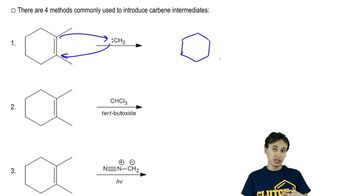
In addition to radicals, anions, and cations, a fourth class of reactive intermediates is carbenes. A neutral species, the simplest carbene has a molecular formula of CH2 .
(e) Carbenes have great synthetic utility, especially in the synthesis of cyclopropanes from alkenes. Based on your answers to (a)–(d), show a mechanism for the cyclopropanation of cyclohexene.
The reaction of (E)-3-chlorohex-3-ene with HCl results in the selective formation of 3,3-dichlorohexane instead of 3,4-dichlorohexane. Explain this result.
In addition to radicals, anions, and cations, a fourth class of reactive intermediates is carbenes. A neutral species, the simplest carbene has a molecular formula of CH2.
(f) Cyclopropanation of (E)- and (Z)-3-methylhex-3-ene gives two different products. Rationalize this outcome.
In addition to radicals, anions, and cations, a fourth class of reactive intermediates is carbenes. A neutral species, the simplest carbene has a molecular formula of CH2.
(b) What are the hybridization and shape of the central carbon of CH2?
The acid-catalyzed hydration we learned here in Chapter 8 is reversible:
(e) How might you shift the equilibrium to the left?