Ch. 7 - Principles of Green (Organic) Chemistry
Mullins - Organic Chemistry: A Learner Centered Approach 1st Edition
Mullins1st EditionOrganic Chemistry: A Learner Centered ApproachISBN: 9780137566471Not the one you use?Change textbook
Chapter 6, Problem 17a

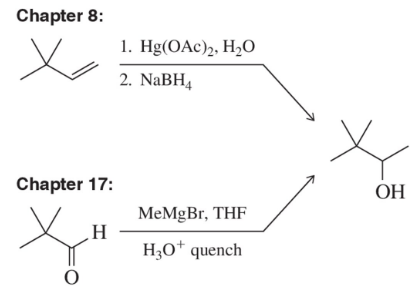
LOOKING AHEAD CHAPTERS 8, 17 In Chapters 8 and 17 we learn two reaction for the synthesis of the alcohol shown. (a) Show a mechanism for each of the reactions. (b) If you were designing a synthetic route, which would be considered more sustainable? Consider all factors. [Assume the starting organic molecules are equally green.]

Verified step by step guidance
1
Step 1: Analyze the reaction from Chapter 8. This reaction involves oxymercuration-demercuration. The first step uses Hg(OAc)₂ and H₂O to add a hydroxyl group (-OH) to the more substituted carbon of the double bond, following Markovnikov's rule. The second step uses NaBH₄ to remove the mercury group and complete the formation of the alcohol.
Step 2: Write the mechanism for the Chapter 8 reaction. (a) The π electrons of the alkene attack Hg(OAc)₂, forming a mercurinium ion intermediate. (b) Water acts as a nucleophile, opening the mercurinium ion and attaching to the more substituted carbon. (c) NaBH₄ reduces the intermediate, replacing the mercury group with a hydrogen atom, yielding the alcohol.
Step 3: Analyze the reaction from Chapter 17. This reaction involves the use of a Grignard reagent (MeMgBr) to attack the carbonyl group of the ketone. The Grignard reagent adds a methyl group (-CH₃) to the carbonyl carbon, forming a tetrahedral alkoxide intermediate. The reaction is quenched with H₃O⁺ to protonate the alkoxide, yielding the alcohol.
Step 4: Write the mechanism for the Chapter 17 reaction. (a) The nucleophilic carbon of the Grignard reagent attacks the electrophilic carbonyl carbon, breaking the π bond and forming a tetrahedral alkoxide intermediate. (b) Acidic workup (H₃O⁺) protonates the alkoxide, yielding the alcohol.
Step 5: Compare sustainability of the two methods. The Chapter 8 reaction uses mercury, which is toxic and environmentally harmful, making it less sustainable. The Chapter 17 reaction uses a Grignard reagent, which is generally considered greener, especially if the magnesium is sourced sustainably. Additionally, the Chapter 17 reaction avoids the use of heavy metals, making it the more sustainable choice overall.

Verified video answer for a similar problem:

This video solution was recommended by our tutors as helpful for the problem above.
Video duration:
8m
Was this helpful?

Key Concepts

Here are the essential concepts you must grasp in order to answer the question correctly.

Reaction Mechanisms

A reaction mechanism is a step-by-step description of the process by which reactants are converted into products. It outlines the individual bond-breaking and bond-forming events that occur during the reaction. Understanding mechanisms is crucial for predicting the outcome of reactions and for designing synthetic pathways, as it provides insight into the stability of intermediates and the energy changes involved.
Recommended video:
Guided course
02:16
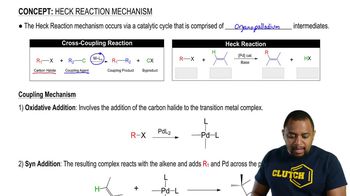
Heck Reaction Mechanism

Sustainability in Organic Synthesis

Sustainability in organic synthesis refers to the design of chemical processes that minimize environmental impact and resource consumption. This includes using renewable resources, reducing waste, and maximizing energy efficiency. When evaluating synthetic routes, factors such as the use of hazardous reagents, byproduct formation, and overall energy requirements must be considered to determine which method is more sustainable.
Recommended video:
1:16
Synthesis of Amino Acids: Strecker Synthesis Example 1

Green Chemistry Principles

Green chemistry principles are guidelines aimed at reducing the environmental and health impacts of chemical processes. These principles encourage the use of safer solvents, the reduction of waste, and the design of energy-efficient reactions. By applying these principles, chemists can develop more sustainable synthetic routes that align with environmental goals while maintaining efficiency and effectiveness in producing desired compounds.
Recommended video:
Guided course
00:28
Introduction to General Chemistry Review