Ch. 6 - Stereoisomerism: Arrangement of Atoms in Space
Mullins - Organic Chemistry: A Learner Centered Approach 1st Edition
Mullins1st EditionOrganic Chemistry: A Learner Centered ApproachISBN: 9780137566471Not the one you use?Change textbook
Chapter 5, Problem 37e

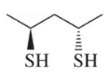
Which of the following compounds are meso?
(e)

Verified step by step guidance
1
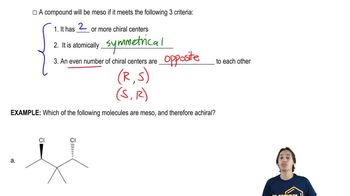
Step 1: Understand the concept of meso compounds. Meso compounds are achiral molecules that contain multiple stereocenters and have an internal plane of symmetry, making them optically inactive.
Step 2: Analyze the given structure. The compound has two stereocenters (marked by the SH groups attached to the carbon atoms). Check the configuration of each stereocenter to determine if they are opposite (R and S).
Step 3: Look for an internal plane of symmetry. Examine the molecule to see if it can be divided into two symmetrical halves, where one side is the mirror image of the other.
Step 4: Verify optical activity. If the molecule has symmetry and the stereocenters cancel each other's optical activity, it is meso. This can be confirmed by the presence of the plane of symmetry.
Step 5: Conclude whether the compound is meso based on the analysis of symmetry and stereocenter configurations.

Verified video answer for a similar problem:

This video solution was recommended by our tutors as helpful for the problem above.
Was this helpful?

Key Concepts

Here are the essential concepts you must grasp in order to answer the question correctly.

Meso Compounds

Meso compounds are a specific type of stereoisomer that possess multiple chiral centers but are achiral due to an internal plane of symmetry. This means that despite having chiral centers, the overall molecule does not exhibit optical activity. Identifying meso compounds involves looking for symmetry in the molecular structure, which can often simplify the analysis of stereochemistry.
Recommended video:
Guided course
04:10
The 3 rules of meso compounds.

Chirality

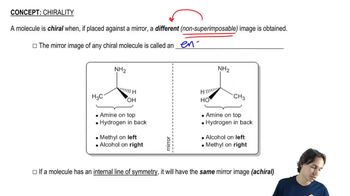
Chirality refers to the property of a molecule that makes it non-superimposable on its mirror image, much like left and right hands. A chiral molecule typically has at least one carbon atom bonded to four different substituents, creating two enantiomers. Understanding chirality is crucial for determining the optical activity and stereochemical behavior of organic compounds.
Recommended video:
Guided course
05:10
What is chirality?

Stereoisomerism

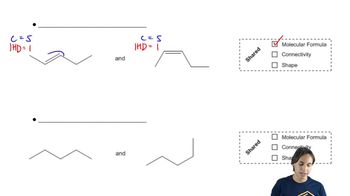
Stereoisomerism is a form of isomerism where compounds have the same molecular formula and connectivity of atoms but differ in the spatial arrangement of those atoms. This category includes both enantiomers and diastereomers, with meso compounds being a unique subset. Recognizing the types of stereoisomers is essential for understanding the reactivity and properties of organic molecules.
Recommended video:
Guided course
01:58
Determining when molecules are stereoisomers.