Ch. 6 - Stereoisomerism: Arrangement of Atoms in Space
Mullins - Organic Chemistry: A Learner Centered Approach 1st Edition
Mullins1st EditionOrganic Chemistry: A Learner Centered ApproachISBN: 9780137566471Not the one you use?Change textbook
Chapter 5, Problem 40a

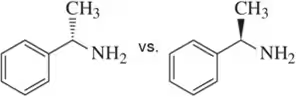
(i) Which of the following pairs of compounds would you expect to have different physical properties?
(ii) What is the relationship between each of the pairs?
(iii) Assign the absolute configuration of each stereocenter to confirm your answer.
(a) Structural comparison of two isomeric compounds featuring amine and methyl groups, highlighting their different configurations.

Verified step by step guidance
1
Step 1: Analyze the given pairs of compounds and determine if they are stereoisomers, constitutional isomers, or identical compounds. This will help identify whether their physical properties differ.
Step 2: For each pair, check the connectivity of atoms. If the connectivity differs, the compounds are constitutional isomers, which typically have different physical properties.
Step 3: If the connectivity is the same, examine the stereochemistry of the compounds. Determine if they are enantiomers (non-superimposable mirror images) or diastereomers (stereoisomers that are not mirror images). Enantiomers often have identical physical properties except for their interaction with polarized light, while diastereomers usually have different physical properties.
Step 4: Assign the absolute configuration (R or S) to each stereocenter in the compounds using the Cahn-Ingold-Prelog priority rules. This involves ranking substituents based on atomic number and determining the spatial arrangement.
Step 5: Compare the absolute configurations of the stereocenters in each pair to confirm the relationship between the compounds and whether their physical properties are expected to differ.

Verified video answer for a similar problem:

This video solution was recommended by our tutors as helpful for the problem above.
Video duration:
2m
Was this helpful?

Key Concepts

Here are the essential concepts you must grasp in order to answer the question correctly.

Stereochemistry

Stereochemistry is the study of the spatial arrangement of atoms in molecules and how this affects their physical and chemical properties. It is crucial for understanding isomers, particularly stereoisomers, which have the same molecular formula but differ in the orientation of their atoms in space. This concept is essential for predicting differences in boiling points, melting points, and reactivity between compounds.
Recommended video:
1:38
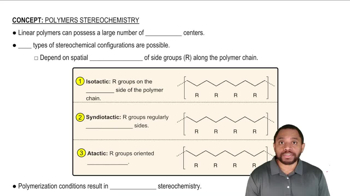
Polymer Stereochemistry Concept 1

Chirality

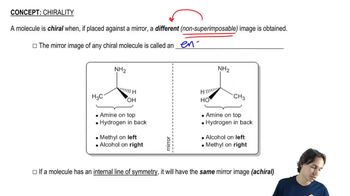
Chirality refers to the property of a molecule that makes it non-superimposable on its mirror image, much like left and right hands. Chiral molecules typically contain one or more stereocenters, which are carbon atoms bonded to four different substituents. The presence of chirality can lead to significant differences in the physical properties and biological activity of enantiomers, making it a key concept in organic chemistry.
Recommended video:
Guided course
05:10
What is chirality?

Physical Properties

Physical properties are characteristics of substances that can be observed or measured without changing the substance's chemical identity. These include boiling point, melting point, solubility, and density. Understanding how structural differences, such as those arising from stereochemistry and chirality, influence these properties is vital for predicting how different compounds will behave in various conditions.
Recommended video:
0:53
Physical Properties of Fatty Acids Concept 1