Ch. 6 - Stereoisomerism: Arrangement of Atoms in Space
Mullins - Organic Chemistry: A Learner Centered Approach 1st Edition
Mullins1st EditionOrganic Chemistry: A Learner Centered ApproachISBN: 9780137566471Not the one you use?Change textbook
Chapter 5, Problem 47f

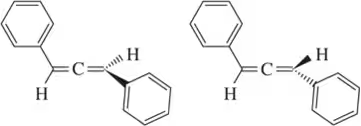
Define the relationship between each set of two molecules as chain isomers, positional isomers, functional group isomers, enantiomers, diastereomers, conformational isomers, or identical
(f) f

Verified step by step guidance
1
Examine the molecular formulas of the two molecules to ensure they are the same. If the molecular formulas differ, the molecules are not isomers.
Compare the connectivity of the atoms in the two molecules. If the connectivity differs but the molecular formula is the same, the molecules could be chain isomers, positional isomers, or functional group isomers.
If the connectivity is the same, analyze the spatial arrangement of the atoms. Check for stereoisomerism, which includes enantiomers and diastereomers. Enantiomers are non-superimposable mirror images, while diastereomers are stereoisomers that are not mirror images.
If the molecules differ only by rotation around a single bond, they are conformational isomers. These are the same molecule in different conformations.
If the molecules are identical in both connectivity and spatial arrangement, they are the same compound. Confirm this by overlaying the structures or using symmetry analysis.

Verified video answer for a similar problem:

This video solution was recommended by our tutors as helpful for the problem above.
Video duration:
2m
Was this helpful?

Key Concepts

Here are the essential concepts you must grasp in order to answer the question correctly.

Isomerism

Isomerism refers to the phenomenon where two or more compounds have the same molecular formula but different structural or spatial arrangements. This leads to distinct physical and chemical properties among the isomers. Understanding isomerism is crucial for analyzing the relationships between different molecules, as it encompasses various types such as structural isomers and stereoisomers.
Recommended video:
Guided course
06:47
Monosaccharides - D and L Isomerism

Structural Isomers

Structural isomers are compounds that share the same molecular formula but differ in the connectivity of their atoms. This category includes chain isomers, which differ in the arrangement of the carbon skeleton, and positional isomers, which have the same functional groups but in different positions. Recognizing these differences is essential for understanding how molecular structure influences reactivity and properties.
Recommended video:
Guided course
01:10
What is a constitutional isomer?

Stereoisomers

Stereoisomers are compounds that have the same molecular formula and connectivity but differ in the spatial arrangement of their atoms. This group includes enantiomers, which are non-superimposable mirror images, and diastereomers, which are not mirror images of each other. The study of stereoisomerism is vital in organic chemistry, particularly in the context of chirality and its implications in biological systems.
Recommended video:
Guided course
01:58
Determining when molecules are stereoisomers.