Ch. 5 - Chemical Reaction Analysis: Thermodynamics and Kinetics
Mullins - Organic Chemistry: A Learner Centered Approach 1st Edition
Mullins1st EditionOrganic Chemistry: A Learner Centered ApproachISBN: 9780137566471Not the one you use?Change textbook
Chapter 4, Problem 16c

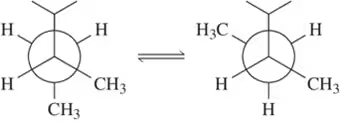
Which conformation in each of the following pairs has the least strain energy?
(c) Newman projections comparing two conformations of a cycloalkane, highlighting strain energy differences.

Verified step by step guidance
1
Identify the type of strain energy present in the molecule. Strain energy can arise from torsional strain (eclipsing interactions), steric strain (atoms or groups being too close to each other), or angle strain (bond angles deviating from their ideal values).
Analyze the conformations in the given pair. For example, if the molecule is a cyclohexane derivative, determine whether the conformation is in a chair, boat, or twist-boat form, as these have different strain energies.
If the molecule is a cyclohexane derivative, evaluate the placement of substituents in axial and equatorial positions. Substituents in the equatorial position generally reduce steric strain compared to axial positions.
Compare the torsional strain in the conformations. For example, staggered conformations (e.g., anti or gauche) typically have lower torsional strain than eclipsed conformations.
Select the conformation with the least strain energy by considering all the factors (torsional, steric, and angle strain) and determining which conformation minimizes these interactions.

Verified video answer for a similar problem:

This video solution was recommended by our tutors as helpful for the problem above.
Video duration:
1m
Was this helpful?

Key Concepts

Here are the essential concepts you must grasp in order to answer the question correctly.

Conformational Analysis

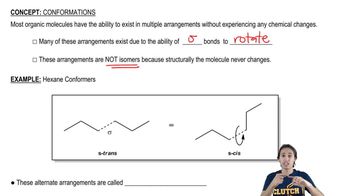
Conformational analysis involves studying the different spatial arrangements of atoms in a molecule that can be interconverted by rotation around single bonds. This analysis helps in understanding the stability of various conformations, as certain arrangements can lead to steric hindrance or torsional strain, affecting the overall energy of the molecule.
Recommended video:
Guided course
03:29
Understanding what a conformer is.

Strain Energy

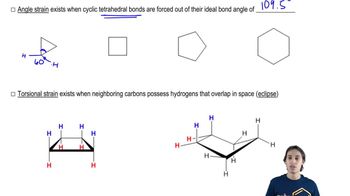
Strain energy refers to the energy stored in a molecule due to the distortion of its normal bond angles and lengths. In organic molecules, factors such as steric strain (from repulsion between atoms) and torsional strain (from eclipsing interactions) contribute to the overall strain energy, influencing the stability and reactivity of different conformations.
Recommended video:
Guided course
02:46
What is angle strain?

Staggered vs. Eclipsed Conformations

In conformational analysis, staggered and eclipsed conformations are two key arrangements of atoms around a single bond. Staggered conformations, where atoms are positioned at maximum distance from each other, generally have lower energy and less strain compared to eclipsed conformations, where atoms are aligned and experience increased steric and torsional strain.
Recommended video:
Guided course
03:29
Understanding what a conformer is.