Textbook Question
For the following acid–base reactions studied in Assessment 5.25, draw a likely transition state. Be sure to indicate in your drawing the degree to which bonds are broken or formed.
(b)
1
views

 Mullins 1st EditionCh. 5 - Chemical Reaction Analysis: Thermodynamics and KineticsProblem 31b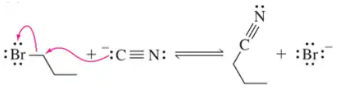
 Verified step by step guidance
 02:16
02:16
 03:
03: 06:20
06:20For the following acid–base reactions studied in Assessment 5.25, draw a likely transition state. Be sure to indicate in your drawing the degree to which bonds are broken or formed.
(b)
We discuss the following reactions in subsequent chapters. Given the mechanisms shown, draw the mechanism of the reverse reaction.
(a)
Write the rate law for the following reaction and identify which molecules are present in the rate-determining step. Draw a possible transition state and propose a mechanism.
Assuming that ∆H° = -15kcal/mol for the reaction in Assessment 5.31(b), show the transition state for the forward and reverse reactions.
For the following acid–base reactions studied in Assessment 5.25, draw a likely transition state. Be sure to indicate in your drawing the degree to which bonds are broken or formed.
(c) H3O+ + Br– ⇌ H2O + HBr
All things being equal, would you expect a first-order reaction to be faster or slower than a second-order reaction?