Ch. 5 - Chemical Reaction Analysis: Thermodynamics and Kinetics
Mullins - Organic Chemistry: A Learner Centered Approach 1st Edition
Mullins1st EditionOrganic Chemistry: A Learner Centered ApproachISBN: 9780137566471Not the one you use?Change textbook
Chapter 4, Problem 38a

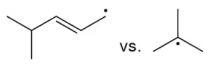
Using bond-dissociation energies, identify the most stable radical. Justify the difference in stability based on the structure.
(a)

Verified step by step guidance
1
Step 1: Analyze the two radicals provided in the image. The first radical is an allylic radical (the unpaired electron is adjacent to a double bond), while the second radical is a tertiary radical (the unpaired electron is on a carbon bonded to three other carbons).
Step 2: Recall that allylic radicals are stabilized by resonance. The unpaired electron in the allylic radical can delocalize over the π-system of the double bond, creating resonance structures. This delocalization increases stability.
Step 3: Compare the bond-dissociation energies (BDEs) of the C-H bonds that would form these radicals. Allylic C-H bonds typically have lower BDEs compared to tertiary C-H bonds due to the resonance stabilization of the allylic radical.
Step 4: Consider hyperconjugation and inductive effects for the tertiary radical. While tertiary radicals are stabilized by hyperconjugation (interaction of the unpaired electron with adjacent C-H bonds) and inductive effects from alkyl groups, this stabilization is generally weaker than the resonance stabilization of allylic radicals.
Step 5: Conclude that the allylic radical is more stable due to resonance stabilization, which is a stronger stabilizing factor compared to hyperconjugation and inductive effects in the tertiary radical.

Verified video answer for a similar problem:

This video solution was recommended by our tutors as helpful for the problem above.
Video duration:
1m
Was this helpful?

Key Concepts

Here are the essential concepts you must grasp in order to answer the question correctly.

Bond-Dissociation Energy

Bond-dissociation energy (BDE) is the energy required to break a specific bond in a molecule, resulting in the formation of radicals. Higher BDE values indicate stronger bonds, which typically correlate with lower stability of the resulting radical. Understanding BDE is crucial for predicting the stability of radicals, as radicals formed from weaker bonds are generally more stable due to lower energy requirements for bond cleavage.
Recommended video:
Guided course
04:09
How to calculate enthalpy using bond dissociation energies.

Radical Stability

Radical stability refers to the relative stability of radical species, which can be influenced by factors such as hybridization, resonance, and steric effects. Generally, tertiary radicals are more stable than secondary, which are more stable than primary radicals. This stability is often due to the ability of surrounding groups to donate electron density to the unpaired electron, thus stabilizing the radical.
Recommended video:
Guided course
03:43
The radical stability trend.

Resonance Effects

Resonance effects occur when a molecule can be represented by multiple valid Lewis structures, allowing for the delocalization of electrons. In the context of radicals, resonance can significantly enhance stability by spreading out the unpaired electron over several atoms, reducing the overall energy of the radical. This concept is essential for evaluating the stability of different radical structures, as resonance-stabilized radicals are generally more stable than those without such delocalization.
Recommended video:
Guided course
03:32
Understanding Resonance Effects