Ch. 5 - Chemical Reaction Analysis: Thermodynamics and Kinetics
Mullins - Organic Chemistry: A Learner Centered Approach 1st Edition
Mullins1st EditionOrganic Chemistry: A Learner Centered ApproachISBN: 9780137566471Not the one you use?Change textbook
Chapter 4, Problem 45b

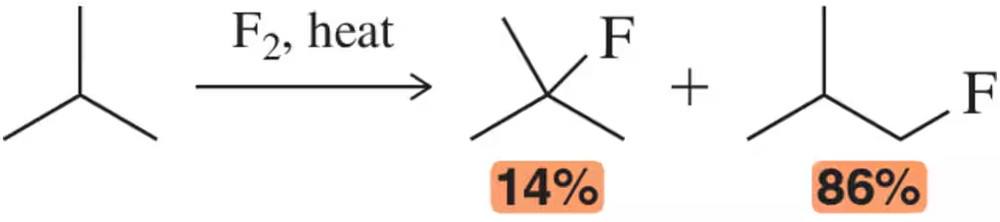
The radical fluorination of 2-methyl propane resulted in a 14:86 ratio of products.
Radical fluorination of 2-methyl propane yielding products in a 14:86 ratio, with F2 and heat indicated.
(b) From the relative reactivity, calculate the difference in energy between the transition states of the first propagation steps leading to a 1° and 3° radical.

Verified step by step guidance
1
Identify the key concept: The problem involves radical halogenation, specifically fluorination, and the relative reactivity of primary (1°) and tertiary (3°) radicals. The energy difference between the transition states can be calculated using the ratio of products and the Boltzmann distribution equation.
Write the Boltzmann distribution equation: \( \frac{[P_1]}{[P_2]} = e^{-\Delta E / RT} \), where \([P_1]\) and \([P_2]\) are the concentrations (or ratios) of the products, \( \Delta E \) is the energy difference between the transition states, \( R \) is the gas constant (8.314 J/mol·K), and \( T \) is the temperature in Kelvin.
Substitute the given product ratio into the equation: The ratio of products is 14:86, so \( \frac{[P_{1°}]}{[P_{3°}]} = \frac{14}{86} \). This ratio corresponds to the relative reactivity of the 1° and 3° radicals.
Rearrange the equation to solve for \( \Delta E \): Take the natural logarithm of both sides to isolate \( \Delta E \). The equation becomes \( \Delta E = -RT \ln \left( \frac{[P_{1°}]}{[P_{3°}]} \right) \).
Plug in the known values: Use \( R = 8.314 \) J/mol·K, the given ratio \( \frac{14}{86} \), and the temperature (assume room temperature, \( T = 298 \) K, unless otherwise specified). Simplify the expression to calculate \( \Delta E \), the energy difference between the transition states.

Verified video answer for a similar problem:

This video solution was recommended by our tutors as helpful for the problem above.
Video duration:
4m
Was this helpful?

Key Concepts

Here are the essential concepts you must grasp in order to answer the question correctly.

Radical Reactivity

Radical reactivity refers to the tendency of different types of radicals to undergo reactions. In organic chemistry, the stability of radicals is crucial; tertiary (3°) radicals are more stable than secondary (2°) and primary (1°) radicals due to hyperconjugation and inductive effects. This stability influences the rate of reactions and the distribution of products formed during radical processes.
Recommended video:
1:30
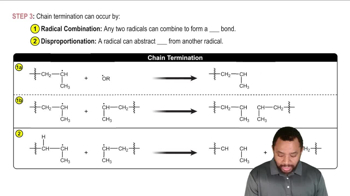
Radical Polymerization Concept 4

Transition States

A transition state is a high-energy state during a chemical reaction that represents the point of maximum energy along the reaction pathway. The energy difference between transition states for different pathways can indicate the relative reactivity of the involved species. In this context, comparing the transition states for forming 1° and 3° radicals helps to understand the energy barriers and the favorability of each reaction pathway.
Recommended video:
Guided course
06:55
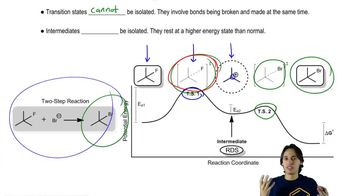
Intermediates vs. Transition States

Energy Calculations in Radical Reactions

Energy calculations in radical reactions involve determining the energy differences between the transition states leading to different products. By using the ratio of products formed, one can apply the principle of microscopic reversibility and the Arrhenius equation to estimate the energy difference. This calculation is essential for predicting the outcome of radical reactions and understanding the underlying thermodynamics.
Recommended video:
Guided course
03:49
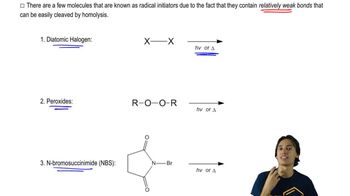
What are Radical Initiators?