Ch. 5 - Chemical Reaction Analysis: Thermodynamics and Kinetics
Mullins - Organic Chemistry: A Learner Centered Approach 1st Edition
Mullins1st EditionOrganic Chemistry: A Learner Centered ApproachISBN: 9780137566471Not the one you use?Change textbook
Chapter 4, Problem 29a

For the following acid–base reactions studied in Assessment 5.25, draw a likely transition state. Be sure to indicate in your drawing the degree to which bonds are broken or formed.
(a) Acid-base reaction diagram showing reactants and products with bond formation and breaking indicated.

Verified step by step guidance
1
Step 1: Identify the reactants and products in the given acid-base reaction. The reactants are tert-butoxide ion (\( (CH_3)_3CO^- \)) and isopropanol (\( (CH_3)_2CHOH \)), while the products are isopropoxide ion (\( (CH_3)_2CHO^- \)) and tert-butanol (\( (CH_3)_3COH \)).
Step 2: Recognize the type of reaction. This is a proton transfer reaction, where the tert-butoxide ion acts as a base and abstracts a proton (H⁺) from isopropanol, forming the isopropoxide ion and tert-butanol.
Step 3: Understand the transition state. The transition state represents the point at which the proton is partially transferred from the isopropanol to the tert-butoxide ion. At this stage, the O-H bond in isopropanol is partially broken, and the O-H bond in tert-butanol is partially formed.
Step 4: Draw the transition state. Use dashed lines to indicate the partial bonds being formed and broken. For example, the O-H bond in isopropanol should be shown as a dashed line to indicate partial breaking, and the O-H bond in tert-butanol should also be shown as a dashed line to indicate partial formation. Include partial charges on the oxygen atoms to reflect the electron density changes during the transition state.
Step 5: Label the transition state. Clearly indicate the transition state with a double dagger symbol (‡) and ensure that all atoms and bonds are properly represented. Highlight the flow of electrons using curved arrows to show the movement of the proton from isopropanol to tert-butoxide.

Verified video answer for a similar problem:

This video solution was recommended by our tutors as helpful for the problem above.
Was this helpful?

Key Concepts

Here are the essential concepts you must grasp in order to answer the question correctly.

Acid-Base Reactions

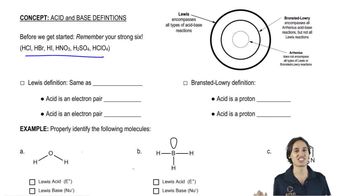
Acid-base reactions involve the transfer of protons (H+) between reactants. An acid donates a proton, while a base accepts it. Understanding the nature of acids and bases, including their strength and the concept of conjugate acid-base pairs, is essential for predicting the outcome of these reactions and drawing accurate transition states.
Recommended video:
Guided course
02:49
The Lewis definition of acids and bases.

Transition States

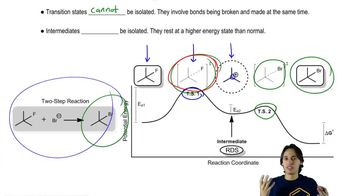
A transition state is a high-energy, unstable arrangement of atoms that occurs during the transformation of reactants into products. It represents the point of maximum energy along the reaction pathway. Drawing a transition state requires an understanding of bond formation and breaking, as well as the geometry of the reacting species at this critical moment.
Recommended video:
Guided course
06:55
Intermediates vs. Transition States

Bond Formation and Breaking

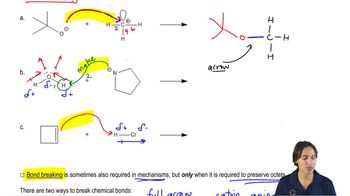
In chemical reactions, bonds between atoms are either formed or broken as reactants convert to products. The extent of bond breaking and forming can be depicted in a transition state diagram, which illustrates the changes in bond lengths and angles. Recognizing how these changes correlate with the energy profile of the reaction is crucial for accurately representing the transition state.
Recommended video:
Guided course
02:31
Identifying Bond Breaking