Ch. 4 - Acids and Bases: Electron Flow
Mullins - Organic Chemistry: A Learner Centered Approach 1st Edition
Mullins1st EditionOrganic Chemistry: A Learner Centered ApproachISBN: 9780137566471Not the one you use?Change textbook
Chapter 3, Problem 9c

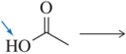
What is the conjugate base of each of the following acids? [The most acidic proton is indicated.]
(c) Diagram showing an acid with the most acidic proton indicated, leading to its conjugate base.

Verified step by step guidance
1
Identify the acid in the given problem and locate the most acidic proton as indicated in the question.
Recall the definition of a conjugate base: it is formed when an acid donates a proton (H⁺). This means you need to remove the most acidic proton from the acid.
Write the chemical structure of the acid and remove the indicated proton. This will result in a species with one less hydrogen atom and a negative charge on the atom that was bonded to the proton.
Ensure that the resulting conjugate base is correctly represented, including the formal charge and any resonance structures if applicable.
Double-check the structure of the conjugate base to confirm that it is consistent with the removal of the most acidic proton and that the negative charge is placed on the appropriate atom.

Verified video answer for a similar problem:

This video solution was recommended by our tutors as helpful for the problem above.
Video duration:
3m
Was this helpful?

Key Concepts

Here are the essential concepts you must grasp in order to answer the question correctly.

Conjugate Acid-Base Pair

A conjugate acid-base pair consists of two species that differ by the presence or absence of a proton (H+). When an acid donates a proton, it forms its conjugate base, while the base that accepts the proton becomes its conjugate acid. Understanding this relationship is crucial for identifying the conjugate base of an acid.
Recommended video:
2:56
Base Pairing Concept 1

Acidity and pKa

Acidity refers to the tendency of a substance to donate protons, and it is quantitatively expressed by the pKa value. The lower the pKa, the stronger the acid, indicating a greater ability to lose a proton. Recognizing the most acidic proton in a molecule helps in determining which proton will be removed to form the conjugate base.
Recommended video:
Guided course
07:45
Identifying pKa values

Proton Transfer Mechanism

The proton transfer mechanism is a fundamental process in acid-base chemistry where a proton is transferred from an acid to a base. This mechanism is essential for understanding how acids and bases interact in solution, and it aids in predicting the formation of conjugate bases when acids lose protons.
Recommended video:
3:05
Polyurethane Mechanism Example 1