Ch. 4 - Acids and Bases: Electron Flow
Mullins - Organic Chemistry: A Learner Centered Approach 1st Edition
Mullins1st EditionOrganic Chemistry: A Learner Centered ApproachISBN: 9780137566471Not the one you use?Change textbook
Chapter 3, Problem 58a

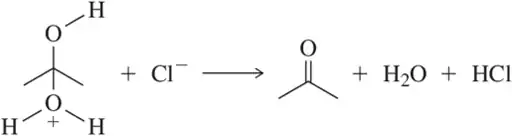
Show an arrow-pushing mechanism that forms the product on the right from the reactant at left. Here, three arrows are necessary in each reaction.
(a) Arrow-pushing mechanism illustrating the reaction of a reactant forming products with three arrows indicating electron movement.

Verified step by step guidance
1
Step 1: Identify the functional groups and reactive sites in the reactant molecule. Look for nucleophilic and electrophilic centers that will participate in the reaction.
Step 2: Determine the type of reaction mechanism involved (e.g., substitution, elimination, addition). Based on the problem, focus on the arrow-pushing mechanism to show electron movement.
Step 3: Draw the first curved arrow to represent the movement of electrons from the nucleophile (electron donor) to the electrophile (electron acceptor). Ensure the arrow starts from a lone pair or bond and points toward the electrophilic center.
Step 4: Draw the second curved arrow to show the breaking of a bond as electrons are redistributed. This typically occurs when a leaving group departs or a bond rearranges.
Step 5: Draw the third curved arrow to complete the formation of the product. This may involve the formation of a new bond or stabilization of charges. Ensure all charges and lone pairs are correctly accounted for in the final structure.

Verified video answer for a similar problem:

This video solution was recommended by our tutors as helpful for the problem above.
Video duration:
4m
Was this helpful?

Key Concepts

Here are the essential concepts you must grasp in order to answer the question correctly.

Arrow-Pushing Mechanism

Arrow-pushing mechanisms are diagrams used in organic chemistry to illustrate the movement of electrons during chemical reactions. Arrows indicate the direction of electron flow, showing how bonds are formed or broken. Understanding this mechanism is crucial for visualizing reaction pathways and predicting the products of reactions.
Recommended video:
Guided course
04:32
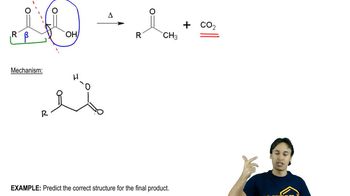
General Mechanism

Nucleophiles and Electrophiles

Nucleophiles are species that donate an electron pair to form a chemical bond, while electrophiles are electron-deficient species that accept an electron pair. Recognizing the roles of nucleophiles and electrophiles in a reaction is essential for understanding how reactants interact and transform into products during the arrow-pushing process.
Recommended video:
Guided course
03:
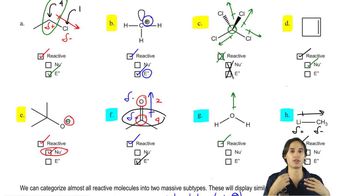
Nucleophile or Electrophile

Reaction Intermediates

Reaction intermediates are transient species that form during the conversion of reactants to products. They are often unstable and exist only for a short time. Identifying these intermediates can help in understanding the stepwise nature of a reaction and the overall mechanism, which is critical for accurately depicting the arrow-pushing process.
Recommended video:
Guided course
04:31
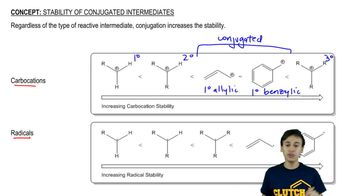
Stability of Conjugated Intermediates