Ch. 4 - Acids and Bases: Electron Flow
Mullins - Organic Chemistry: A Learner Centered Approach 1st Edition
Mullins1st EditionOrganic Chemistry: A Learner Centered ApproachISBN: 9780137566471Not the one you use?Change textbook
Chapter 3, Problem 12c

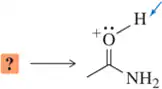
Identify the base from which the following conjugate acids were formed. [The most acidic proton is indicated.]
(c) Diagram showing a molecule with a highlighted acidic proton and a question mark indicating the base for the conjugate acid.

Verified step by step guidance
1
Identify the conjugate acid provided in the problem. A conjugate acid is formed when a base gains a proton (H⁺). Look for the structure of the conjugate acid and locate the proton that is indicated as the most acidic.
Remove the most acidic proton (H⁺) from the conjugate acid. This step involves deprotonation, which is the reverse of protonation. The removal of this proton will yield the base from which the conjugate acid was formed.
Analyze the resulting structure after deprotonation. Ensure that the charge and bonding are correctly adjusted. For example, if the proton was removed from an oxygen atom, the oxygen will now carry a negative charge (O⁻).
Determine the identity of the base. The base is the species that remains after the conjugate acid loses its proton. Compare the structure to known functional groups or molecules to name the base.
Verify your answer by considering the acid-base relationship. The conjugate acid-base pair should differ by exactly one proton. Ensure that the base you identified can accept a proton to regenerate the original conjugate acid.

Verified video answer for a similar problem:

This video solution was recommended by our tutors as helpful for the problem above.
Video duration:
1m
Was this helpful?

Key Concepts

Here are the essential concepts you must grasp in order to answer the question correctly.

Conjugate Acids and Bases

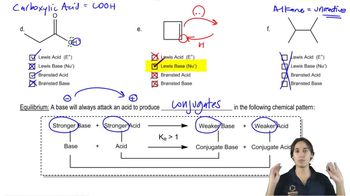
In acid-base chemistry, a conjugate acid is formed when a base accepts a proton (H+), while a conjugate base is what remains after an acid donates a proton. Understanding this relationship is crucial for identifying the base from which a conjugate acid is derived, as it directly relates to the proton transfer process.
Recommended video:
Guided course
02:11
Equilibrium constant and conjugates.

Acidity and pKa

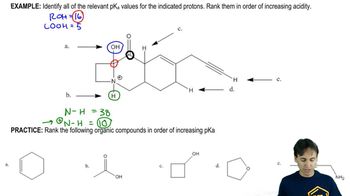
Acidity is a measure of how readily a substance donates protons in solution, often quantified by the pKa value. The lower the pKa, the stronger the acid, indicating a greater tendency to lose a proton. Recognizing the most acidic proton in a molecule helps in determining the corresponding base, as it highlights the site of proton donation.
Recommended video:
Guided course
07:45
Identifying pKa values

Proton Transfer Mechanism

The proton transfer mechanism is a fundamental process in organic chemistry where protons are transferred between molecules, influencing their reactivity and stability. This mechanism is essential for understanding how conjugate acids and bases interconvert, allowing for the identification of the base from which a given conjugate acid is formed.
Recommended video:
3:05
Polyurethane Mechanism Example 1