Ch. 4 - Acids and Bases: Electron Flow
Mullins - Organic Chemistry: A Learner Centered Approach 1st Edition
Mullins1st EditionOrganic Chemistry: A Learner Centered ApproachISBN: 9780137566471Not the one you use?Change textbook
Chapter 3, Problem 32

How do you know that a proton with a low pKa value is acidic (besides 'I just remember')?

Verified step by step guidance
1
Understand the concept of pKₐ: The pKₐ value is a measure of the strength of an acid. It is the negative logarithm of the acid dissociation constant (Kₐ), which quantifies how easily a proton (H⁺) is released from an acid molecule. Mathematically, pKₐ = -log(Kₐ). Lower pKₐ values correspond to stronger acids because they dissociate more readily in solution.
Relate pKₐ to proton acidity: A proton associated with a molecule is considered acidic if it can be easily donated to a base. Molecules with low pKₐ values have protons that are more likely to dissociate, making them more acidic. This is because a low pKₐ indicates a high Kₐ, meaning the equilibrium strongly favors the dissociated form (H⁺ and the conjugate base).
Examine molecular structure and stability: Acidity is influenced by the stability of the conjugate base formed after the proton is donated. If the conjugate base is stabilized (e.g., through resonance, inductive effects, or electronegativity), the proton is more likely to dissociate, resulting in a lower pKₐ value. For example, carboxylic acids have low pKₐ values because their conjugate bases are resonance-stabilized.
Consider solvent effects: The solvent can also affect the acidity of a proton. In polar solvents, acidic protons are more likely to dissociate because the solvent stabilizes the ions formed during dissociation. This contributes to the observed low pKₐ values for strong acids in aqueous solutions.
Apply this knowledge to predict acidity: When analyzing a molecule, look for factors such as electronegativity of the atom bonded to the proton, resonance stabilization of the conjugate base, and inductive effects from nearby electronegative groups. These factors collectively explain why a proton with a low pKₐ value is acidic, beyond simply memorizing the value.

Verified video answer for a similar problem:

This video solution was recommended by our tutors as helpful for the problem above.
Was this helpful?

Key Concepts

Here are the essential concepts you must grasp in order to answer the question correctly.

pKₐ and Acidity

The pKₐ value is a quantitative measure of the strength of an acid in solution. It is the negative logarithm of the acid dissociation constant (Kₐ), which indicates how readily an acid donates protons (H⁺) to the solution. A lower pKₐ value signifies a stronger acid, meaning it dissociates more completely in water, thus increasing the concentration of protons and making the solution more acidic.
Recommended video:
Guided course
02:23
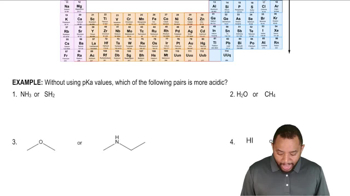
Using factors affecting acidity to rank acids

Acid-Base Equilibrium

Acid-base equilibrium refers to the balance between the concentrations of acids and their conjugate bases in a solution. When an acid donates a proton, it forms its conjugate base. The position of this equilibrium is influenced by the strength of the acid, which is reflected in its pKₐ value. Understanding this equilibrium helps predict how changes in concentration or pH affect the acidity of a solution.
Recommended video:
Guided course
04:00
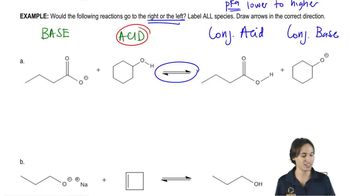
Determining Acid/Base Equilibrium

Factors Affecting Acidity

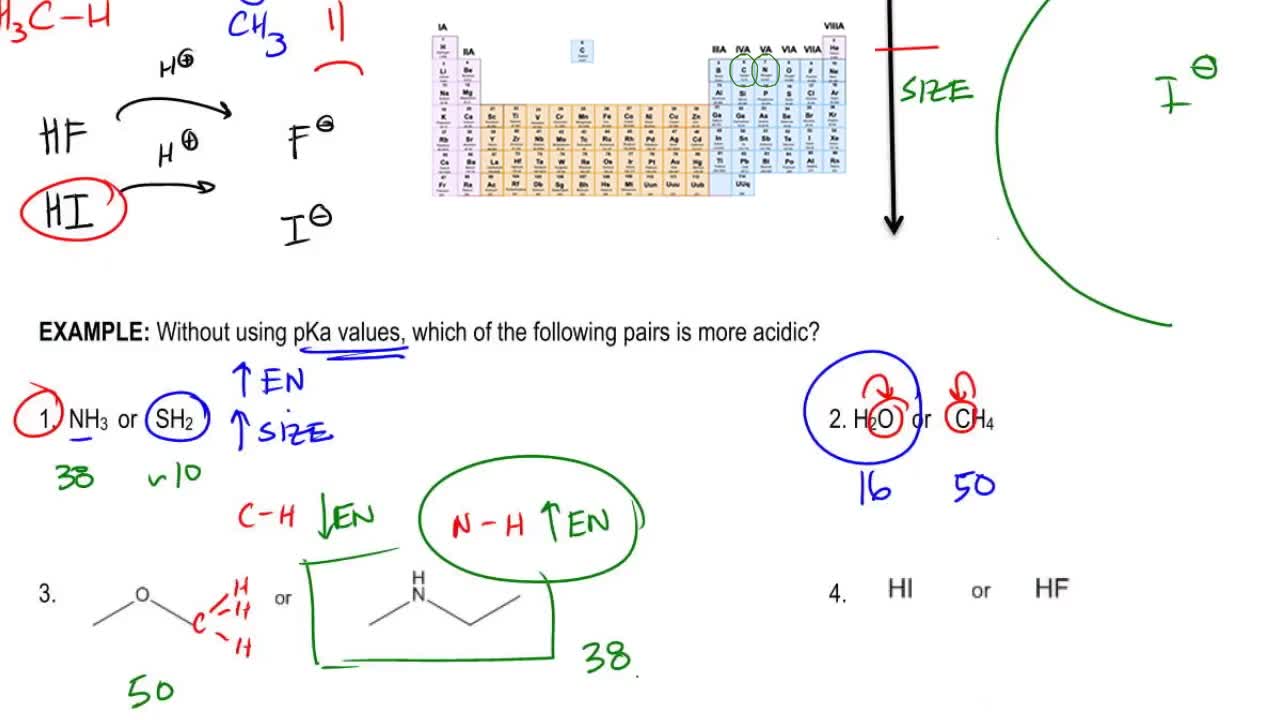
Several factors influence the acidity of a compound, including electronegativity, atomic size, and resonance stabilization. For instance, if the conjugate base of an acid is stabilized by resonance, the acid will be stronger and have a lower pKₐ. Additionally, the presence of electronegative atoms can pull electron density away from the bond to the proton, making it easier for the acid to donate the proton and thus increasing its acidity.
Recommended video:
Guided course
00:57
Using factors affecting acidity to rank acids