Ch. 4 - Acids and Bases: Electron Flow
Mullins - Organic Chemistry: A Learner Centered Approach 1st Edition
Mullins1st EditionOrganic Chemistry: A Learner Centered ApproachISBN: 9780137566471Not the one you use?Change textbook
Chapter 3, Problem 23b

Given the Keq values for the following acid–base reactions, identify the strongest acid and the strongest base.
(b) Chemical reaction diagram showing acid-base equilibrium with Keq value of 10^12, illustrating reactants and products.

Verified step by step guidance
1
Step 1: Analyze the equilibrium constant (K_eq) provided in the reaction. A very large K_eq value, such as 1.0 × 10^20, indicates that the reaction strongly favors the products. This suggests that the conjugate acid and conjugate base on the product side are weaker than the acid and base on the reactant side.
Step 2: Identify the acids and bases in the reaction. On the reactant side, methanamine (CH3NH2) acts as the acid, and methanide (CH3⁻) acts as the base. On the product side, methane (CH4) is the conjugate acid, and methylamide (CH3NH⁻) is the conjugate base.
Step 3: Compare the strength of the acids. Methane (CH4) is the conjugate acid of methanide (CH3⁻), and methanamine (CH3NH2) is the acid on the reactant side. Since the equilibrium strongly favors the formation of methane, methane is the weaker acid, making methanamine the stronger acid.
Step 4: Compare the strength of the bases. Methylamide (CH3NH⁻) is the conjugate base of methanamine (CH3NH2), and methanide (CH3⁻) is the base on the reactant side. Since the equilibrium strongly favors the formation of methylamide, methylamide is the weaker base, making methanide the stronger base.
Step 5: Conclude that the strongest acid in the reaction is methanamine (CH3NH2), and the strongest base is methanide (CH3⁻).

Verified video answer for a similar problem:

This video solution was recommended by our tutors as helpful for the problem above.
Video duration:
3m
Was this helpful?

Key Concepts

Here are the essential concepts you must grasp in order to answer the question correctly.

Acid-Base Equilibrium

Acid-base equilibrium refers to the state in which the rates of the forward and reverse reactions of an acid-base reaction are equal, resulting in constant concentrations of reactants and products. The equilibrium constant (K_eq) quantifies this balance, with larger values indicating a stronger tendency for the reaction to favor products, thus identifying stronger acids and bases.
Recommended video:
Guided course
04:00
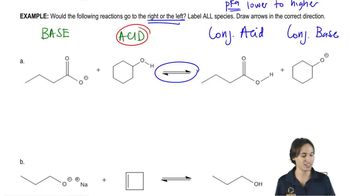
Determining Acid/Base Equilibrium

Strength of Acids and Bases

The strength of an acid or base is determined by its ability to donate protons (H+) or accept protons, respectively. Stronger acids have higher K_eq values, indicating they dissociate more completely in solution, while stronger bases have a greater tendency to accept protons. In the context of the given reaction, comparing K_eq values helps identify the strongest acid and base.
Recommended video:
2:50
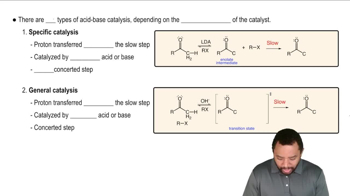
Acid-Base Catalysis Concept 3

Conjugate Acid-Base Pairs

Conjugate acid-base pairs consist of an acid and its corresponding base that differ by a single proton. In the reaction provided, methanide and methanamine are conjugate pairs with their respective products, methylamide and methane. Understanding these pairs is crucial for determining the relative strengths of acids and bases based on their K_eq values.
Recommended video:
2:56
Base Pairing Concept 1