Ch. 4 - Acids and Bases: Electron Flow
Mullins - Organic Chemistry: A Learner Centered Approach 1st Edition
Mullins1st EditionOrganic Chemistry: A Learner Centered ApproachISBN: 9780137566471Not the one you use?Change textbook
Chapter 3, Problem 62e(iii)

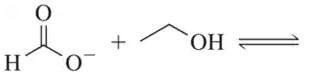
For the following acid–base pairs, (iii) predict the favored side of equilibrium;
(e)

Verified step by step guidance
1
Identify the acid and base on both sides of the equilibrium. On the left side, the acid is ethanol (CH₃CH₂OH), and the base is the formate ion (HCOO⁻). On the right side, the conjugate acid is formic acid (HCOOH), and the conjugate base is the ethoxide ion (CH₃CH₂O⁻).
Determine the relative acidity of the acids on both sides of the equilibrium. Compare the pKa values: formic acid (HCOOH) has a pKa of approximately 3.75, while ethanol (CH₃CH₂OH) has a pKa of approximately 16. This indicates that formic acid is a much stronger acid than ethanol.
Analyze the stability of the conjugate bases. The formate ion (HCOO⁻) is resonance-stabilized, making it more stable than the ethoxide ion (CH₃CH₂O⁻), which lacks resonance stabilization.
Apply the principle that equilibrium favors the side with the weaker acid and the more stable conjugate base. Since formic acid is the stronger acid and the formate ion is the more stable conjugate base, the equilibrium will favor the left side.
Conclude that the favored side of the equilibrium is the side with ethanol (CH₃CH₂OH) and the formate ion (HCOO⁻), as this combination represents the weaker acid and the more stable conjugate base.

Verified video answer for a similar problem:

This video solution was recommended by our tutors as helpful for the problem above.
Was this helpful?

Key Concepts

Here are the essential concepts you must grasp in order to answer the question correctly.

Acid-Base Theory

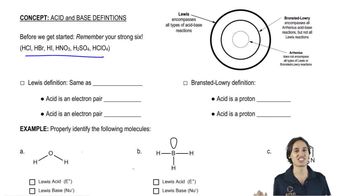
Acid-base theory explains the behavior of acids and bases in chemical reactions. According to the Brønsted-Lowry theory, acids are proton donors while bases are proton acceptors. Understanding this concept is crucial for predicting the direction of equilibrium in acid-base reactions, as the stronger acid will favor the formation of the weaker acid and the stronger base will favor the formation of the weaker base.
Recommended video:
Guided course
02:49
The Lewis definition of acids and bases.

Equilibrium Constant (K)

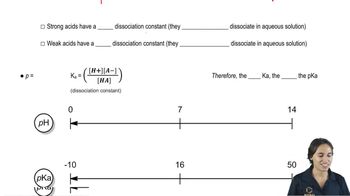
The equilibrium constant (K) quantifies the ratio of the concentrations of products to reactants at equilibrium for a given reaction. A larger K value indicates that the products are favored at equilibrium, while a smaller K value suggests that the reactants are favored. This concept is essential for predicting the favored side of equilibrium in acid-base reactions, as it helps determine which side has a greater tendency to form.
Recommended video:
Guided course
02:19
The relationship between equilibrium constant and pKa.

pKa and pKb Values

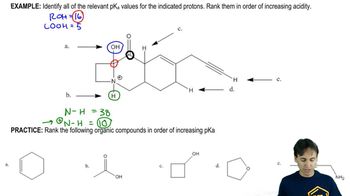
pKa and pKb values are measures of the strength of acids and bases, respectively. The pKa value indicates the acidity of a compound, with lower values signifying stronger acids, while the pKb value indicates the basicity, with lower values signifying stronger bases. These values are critical for predicting the favored side of equilibrium, as they allow for comparison of the strengths of the acids and bases involved in the reaction.
Recommended video:
Guided course
07:45
Identifying pKa values