Ch. 4 - Acids and Bases: Electron Flow
Mullins - Organic Chemistry: A Learner Centered Approach 1st Edition
Mullins1st EditionOrganic Chemistry: A Learner Centered ApproachISBN: 9780137566471Not the one you use?Change textbook
Chapter 3, Problem 40c

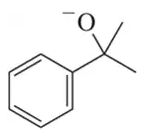
For the bases shown, draw the conjugate acid and identify a pKa value from Table 4.5 that would help you accurately estimate its stability.
(c)

Verified step by step guidance
1
Step 1: Identify the base in the given structure. The base shown is an alkoxide ion, specifically a phenyl isopropyl alkoxide (C₆H₅-CH(CH₃)₂-O⁻). The negatively charged oxygen atom indicates that this is a base.
Step 2: Draw the conjugate acid of the base. To form the conjugate acid, add a proton (H⁺) to the negatively charged oxygen atom. This results in the structure C₆H₅-CH(CH₃)₂-OH, which is an alcohol.
Step 3: Recall the relationship between conjugate acids and bases. The conjugate acid is less basic and more stable than the base due to the addition of a proton, which neutralizes the negative charge.
Step 4: Use Table 4.5 to identify the pKₐ value of the conjugate acid. Alcohols typically have pKₐ values around 16-18, depending on the specific structure. The stability of the conjugate acid can be estimated using this pKₐ value.
Step 5: Analyze the stability of the conjugate acid. The phenyl group and isopropyl group may contribute to steric hindrance and electronic effects, which can slightly influence the pKₐ value and stability. Compare this to other alcohols in Table 4.5 for a more accurate estimation.

Verified video answer for a similar problem:

This video solution was recommended by our tutors as helpful for the problem above.
Was this helpful?

Key Concepts

Here are the essential concepts you must grasp in order to answer the question correctly.

Conjugate Acids and Bases

In acid-base chemistry, a conjugate acid is formed when a base accepts a proton (H⁺). Understanding this concept is crucial for predicting the behavior of substances in reactions. For example, when ammonia (NH₃) acts as a base, it can accept a proton to form ammonium (NH₄⁺), its conjugate acid.
Recommended video:
Guided course
02:11
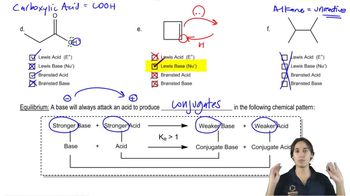
Equilibrium constant and conjugates.

pKₐ and Acid Strength

pKₐ is a quantitative measure of the strength of an acid in solution; it is the negative logarithm of the acid dissociation constant (Kₐ). A lower pKₐ value indicates a stronger acid, which dissociates more completely in solution. This concept is essential for comparing the stability of conjugate acids formed from different bases.
Recommended video:
Guided course
03:09
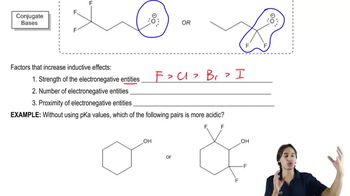
The 3 factors that determine the strength of inductive effects.

Stability of Conjugate Acids

The stability of a conjugate acid is influenced by factors such as electronegativity, resonance, and inductive effects. A more stable conjugate acid corresponds to a stronger base, as it is less likely to donate a proton. Evaluating stability helps in predicting the direction of acid-base reactions and the relative strengths of acids and bases.
Recommended video:
Guided course
04:31
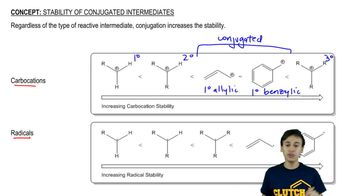
Stability of Conjugated Intermediates