Ch. 4 - Acids and Bases: Electron Flow
Mullins - Organic Chemistry: A Learner Centered Approach 1st Edition
Mullins1st EditionOrganic Chemistry: A Learner Centered ApproachISBN: 9780137566471Not the one you use?Change textbook
Chapter 3, Problem 65

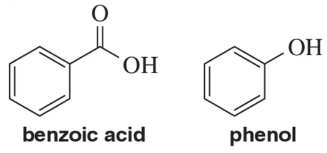
Benzoic acid and phenol are insoluble in water. When sodium bicarbonate is added to the water, benzoic acid dissolves, but phenol does not. The addition of sodium hydroxide causes both to dissolve. On the basis of these observations, estimate the pKa of phenol. [The pKa of H2CO3 is 6.4.]

Verified step by step guidance
1
Step 1: Analyze the solubility behavior of benzoic acid and phenol in water. Benzoic acid and phenol are both weak acids and are insoluble in water due to their nonpolar aromatic rings. However, their solubility changes upon the addition of bases like sodium bicarbonate and sodium hydroxide.
Step 2: Understand the reaction of benzoic acid with sodium bicarbonate. Benzoic acid reacts with sodium bicarbonate (NaHCO₃), a weak base, to form its conjugate base (benzoate ion) and carbonic acid (H₂CO₃). Carbonic acid has a pKa of 6.4, meaning sodium bicarbonate can deprotonate acids with pKa values lower than 6.4. This indicates that benzoic acid has a pKa lower than 6.4, allowing it to dissolve in water as its conjugate base.
Step 3: Examine the behavior of phenol with sodium bicarbonate. Phenol does not dissolve in water upon the addition of sodium bicarbonate, indicating that its pKa is higher than 6.4. Sodium bicarbonate is not strong enough to deprotonate phenol, so phenol remains undissolved.
Step 4: Consider the reaction of phenol with sodium hydroxide. Sodium hydroxide (NaOH) is a strong base and can deprotonate phenol, forming the phenoxide ion, which is soluble in water. This confirms that phenol is acidic but weaker than benzoic acid.
Step 5: Estimate the pKa of phenol based on the observations. Since phenol does not react with sodium bicarbonate (pKa of H₂CO₃ = 6.4) but reacts with sodium hydroxide, its pKa must be higher than 6.4 but low enough to be deprotonated by a strong base like NaOH. Phenol's pKa is typically around 10, consistent with these observations.

Verified video answer for a similar problem:

This video solution was recommended by our tutors as helpful for the problem above.
Video duration:
2m
Was this helpful?

Key Concepts

Here are the essential concepts you must grasp in order to answer the question correctly.

Acid-Base Chemistry

Acid-base chemistry involves the study of proton donors (acids) and proton acceptors (bases). The strength of an acid is often measured by its dissociation constant (Ka), which indicates how well it donates protons in solution. The pKa value is the negative logarithm of Ka, providing a more convenient scale for comparing acid strengths. In this context, benzoic acid is a stronger acid than phenol, which influences their solubility in the presence of bases.
Recommended video:
Guided course
02:49
The Lewis definition of acids and bases.

Solubility and Ionization

The solubility of compounds in water is significantly affected by their ability to ionize. Benzoic acid can donate a proton to form its conjugate base, which is soluble in water, especially when sodium bicarbonate is present. In contrast, phenol does not ionize as readily, making it less soluble in water. The addition of strong bases like sodium hydroxide can deprotonate both compounds, increasing their solubility through ionization.
Recommended video:
Guided course
04:28
Ionization Potentials

pKa Estimation

Estimating the pKa of phenol involves understanding its relative acidity compared to known acids. Given that the pKa of carbonic acid (H₂CO₃) is 6.4, and knowing that phenol is a weaker acid than benzoic acid, which has a pKa around 4.2, one can infer that the pKa of phenol is likely higher than 6.4. This estimation is crucial for predicting the behavior of phenol in various chemical environments.
Recommended video:
Guided course
07:45
Identifying pKa values