Ch. 3 - Alkanes and Cycloalkanes: Properties and Conformational Analysis
Mullins - Organic Chemistry: A Learner Centered Approach 1st Edition
Mullins1st EditionOrganic Chemistry: A Learner Centered ApproachISBN: 9780137566471Not the one you use?Change textbook
Chapter 2, Problem 32c

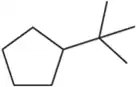
Name the following cycloalkanes using the IUPAC system of nomenclature. [Hint: Each molecule exemplifies one of the cycloalkane nomenclature rules in Table 3.10.]
(c) rule 2
Structural formula of a cycloalkane with a five-membered ring and a branched substituent.

Verified step by step guidance
1
Identify the parent cycloalkane: Look at the structure of the molecule and determine the number of carbons in the ring. The parent name will be based on the number of carbons in the ring (e.g., cyclopropane for 3 carbons, cyclobutane for 4 carbons, etc.).
Apply Rule 2: If there is a substituent attached to the cycloalkane, the ring is considered the parent structure unless the substituent has more carbons than the ring. In that case, the substituent becomes the parent chain, and the ring is treated as a substituent.
Number the ring: Assign numbers to the carbons in the ring such that the substituent(s) receive the lowest possible number(s). Start numbering from the carbon attached to the substituent and proceed in the direction that minimizes the numbers.
Name the substituent(s): Identify the substituent(s) attached to the ring and name them according to their structure (e.g., methyl, ethyl, etc.).
Combine the names: Write the name of the substituent(s) followed by the name of the parent cycloalkane. Use a hyphen to separate the substituent's position number from its name. If there are multiple substituents, list them in alphabetical order and use prefixes (e.g., di-, tri-) if necessary.

Verified video answer for a similar problem:

This video solution was recommended by our tutors as helpful for the problem above.
Video duration:
3m
Was this helpful?

Key Concepts

Here are the essential concepts you must grasp in order to answer the question correctly.

Cycloalkanes

Cycloalkanes are a class of hydrocarbons characterized by carbon atoms arranged in a ring structure, with single bonds between them. They follow the general formula CnH2n, where n is the number of carbon atoms. Understanding cycloalkanes is essential for applying nomenclature rules, as their unique structure influences how they are named and classified.
Recommended video:
Guided course
01:11
How to find the root name for cycloalkanes

IUPAC Nomenclature

The International Union of Pure and Applied Chemistry (IUPAC) nomenclature provides a systematic method for naming chemical compounds. For cycloalkanes, specific rules dictate how to identify the parent chain, number the carbon atoms, and denote substituents. Familiarity with these rules is crucial for accurately naming cycloalkanes and understanding their structural features.
Recommended video:
Guided course
03:43
The different parts of an IUPAC name

Nomenclature Rules for Cycloalkanes

Nomenclature rules for cycloalkanes include guidelines such as identifying the largest ring, numbering the carbon atoms to give the lowest possible numbers to substituents, and using prefixes to indicate the number of identical substituents. Rule 2 specifically emphasizes the importance of numbering the ring in a way that prioritizes substituents, which is vital for correctly naming the compounds in the question.
Recommended video:
Guided course
01:11
How to find the root name for cycloalkanes