Ch. 3 - Alkanes and Cycloalkanes: Properties and Conformational Analysis
Mullins - Organic Chemistry: A Learner Centered Approach 1st Edition
Mullins1st EditionOrganic Chemistry: A Learner Centered ApproachISBN: 9780137566471Not the one you use?Change textbook
Chapter 2, Problem 53l

Given the following structures, show the Newman projection that would result from looking down the indicated bond in the direction shown. [Orient yourself as if you were the eyeball looking down the bond. Some of the examples have been partially completed for you to fill in the rest.]
(l) <IMAGE>

Verified step by step guidance
1
Step 1: Identify the bond you are looking down. In a Newman projection, you are visualizing the molecule as if you are looking directly along the axis of a specific bond. Orient yourself as the 'eyeball' looking down the bond as indicated in the problem.
Step 2: Determine the front and back carbon atoms of the bond. The front carbon is the one closest to your 'eyeball,' and the back carbon is the one farther away. Label these carbons for clarity.
Step 3: Analyze the substituents attached to both the front and back carbons. For the front carbon, draw three substituents radiating outward from the center of a circle (representing the front carbon). For the back carbon, draw three substituents radiating outward from behind the circle (representing the back carbon).
Step 4: Use the line-angle drawing provided to determine the spatial arrangement of the substituents. Pay attention to the stereochemistry and relative positions of groups (e.g., staggered or eclipsed conformations). Place the substituents in their correct positions around the front and back carbons.
Step 5: Draw the final Newman projection, ensuring that the substituents are correctly placed relative to each other. Double-check that the orientation matches the perspective indicated in the problem (e.g., staggered or eclipsed).

Verified video answer for a similar problem:

This video solution was recommended by our tutors as helpful for the problem above.
Video duration:
3m
Was this helpful?

Key Concepts

Here are the essential concepts you must grasp in order to answer the question correctly.

Newman Projections

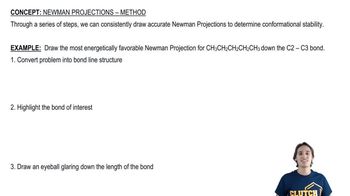
Newman projections are a way to visualize the conformation of a molecule by looking straight down a bond connecting two carbon atoms. This representation helps in understanding the spatial arrangement of substituents around the bond, which is crucial for analyzing steric interactions and torsional strain in organic compounds.
Recommended video:
Guided course
00:34
Introduction to Drawing Newman Projections

Conformational Analysis

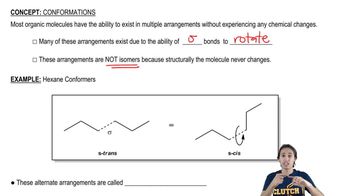
Conformational analysis involves studying the different spatial arrangements of atoms in a molecule that can be interconverted by rotation around single bonds. This analysis is essential for predicting the stability of various conformers, as certain arrangements may lead to increased steric hindrance or torsional strain, affecting the molecule's reactivity and properties.
Recommended video:
Guided course
03:29
Understanding what a conformer is.

Line-Angle Drawings

Line-angle drawings, or skeletal structures, are a shorthand representation of organic molecules where vertices represent carbon atoms and lines represent bonds. This notation simplifies the depiction of complex structures by omitting hydrogen atoms and explicitly showing only the connectivity of the carbon skeleton, making it easier to visualize and analyze molecular conformations.
Recommended video:
Guided course
02:46
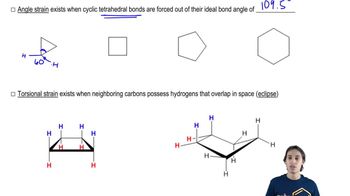
What is angle strain?
Related Practice
Textbook Question

For each pair of conformations shown, choose which is most stable. [If both conformations have the same number of gauche interactions, choose the one where the interactions are between smaller groups.]

(f)

1
views

Textbook Question

Given the following structures, show the Newman projection that would result from looking down the indicated bond in the direction shown. [Orient yourself as if you were the eyeball looking down the bond. Some of the examples have been partially completed for you to fill in the rest.]

(i) <IMAGE>

2
views
Textbook Question

Given the following structures, show the Newman projection that would result from looking down the indicated bond in the direction shown. [Orient yourself as if you were the eyeball looking down the bond. Some of the examples have been partially completed for you to fill in the rest.]

(j) <IMAGE>

1
views
Textbook Question

For each pair of conformations shown, choose which is most stable. [If both conformations have the same number of gauche interactions, choose the one where the interactions are between smaller groups.]

(e)

7
views
Textbook Question

Looking down the indicated bond, show the three most stable conformations and choose the one that is most stable. Be sure that the first Newman projection you show is the one you see initially (before rotation). [Why should none of your three Newman projections show eclipsed conformations?]

(b) <IMAGE>

2
views
Textbook Question

Given the following structures, show the Newman projection that would result from looking down the indicated bond in the direction shown. [Orient yourself as if you were the eyeball looking down the bond. Some of the examples have been partially completed for you to fill in the rest.]

(k) <IMAGE>

6
views