Ch. 3 - Alkanes and Cycloalkanes: Properties and Conformational Analysis
Mullins - Organic Chemistry: A Learner Centered Approach 1st Edition
Mullins1st EditionOrganic Chemistry: A Learner Centered ApproachISBN: 9780137566471Not the one you use?Change textbook
Chapter 2, Problem 10b

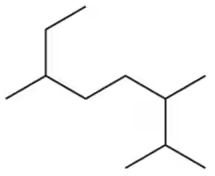
For each of the following line-angle drawings, 
(i) give the number of carbons, 
(ii) label the carbons, 
(iii) tell how many hydrogens are on each carbon, and 
(iv) draw the hybrid structural formula.
(b)

Verified step by step guidance
1
Step 1: Count the number of carbons in the line-angle drawing. Each vertex and endpoint represents a carbon atom. Carefully trace the structure to ensure all carbons are accounted for.
Step 2: Label each carbon atom sequentially, starting from one end of the structure. Assign numbers to each carbon to make it easier to reference them in subsequent steps.
Step 3: Determine the number of hydrogens attached to each carbon. Recall that carbon forms four bonds total, so subtract the number of bonds to other atoms (including other carbons) from four to find the number of hydrogens.
Step 4: Draw the hybrid structural formula. Replace the line-angle drawing with a detailed structure showing all carbons, hydrogens, and bonds explicitly. Ensure the connectivity matches the original line-angle drawing.
Step 5: Double-check your work to ensure the number of carbons, hydrogens, and the hybrid structural formula are consistent with the original line-angle drawing.

Verified video answer for a similar problem:

This video solution was recommended by our tutors as helpful for the problem above.
Was this helpful?

Key Concepts

Here are the essential concepts you must grasp in order to answer the question correctly.

Line-Angle Drawings

Line-angle drawings, also known as skeletal structures, are a simplified way to represent organic molecules. In these drawings, vertices represent carbon atoms, and lines represent bonds between them. Hydrogen atoms attached to carbons are usually omitted for clarity, as they are implied by the tetravalency of carbon. Understanding how to interpret these drawings is essential for identifying the number of carbons and their connectivity.
Recommended video:
Guided course
02:46
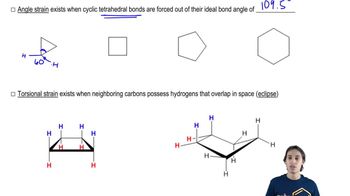
What is angle strain?

Hybridization

Hybridization is the concept that describes the mixing of atomic orbitals to form new hybrid orbitals, which can explain the geometry of molecular bonding. In organic chemistry, common hybridizations include sp3, sp2, and sp, corresponding to different types of carbon bonding (single, double, and triple bonds, respectively). Recognizing the hybridization of each carbon atom helps in determining the number of hydrogen atoms attached to it and the overall structure of the molecule.
Recommended video:
Guided course
10:43
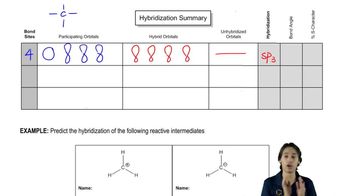
Using bond sites to predict hybridization

Valency and Hydrogen Count

Valency refers to the ability of an atom to bond with other atoms, which is particularly important for carbon, as it typically forms four bonds. The number of hydrogen atoms attached to a carbon atom can be deduced from its valency and the types of bonds it forms with other atoms. For example, a carbon with four single bonds (sp3 hybridized) will have three hydrogen atoms, while a carbon involved in a double bond (sp2 hybridized) will have two hydrogens. Understanding valency is crucial for accurately labeling carbons and determining their hydrogen counts.
Recommended video:
Guided course
07:07
Electron Counting