Ch. 25 - Amines: Structure, Reactions, and Synthesis
Mullins - Organic Chemistry: A Learner Centered Approach 1st Edition
Mullins1st EditionOrganic Chemistry: A Learner Centered ApproachISBN: 9780137566471Not the one you use?Change textbook
Chapter 24, Problem 1

Draw the Lewis structure of azidomethane (CH3N3) [Show two important resonance structures.]

Verified step by step guidance
1
Step 1: Begin by identifying the total number of valence electrons in azidomethane (CH₃N₃). Carbon (C) has 4 valence electrons, hydrogen (H) has 1 valence electron each (3 hydrogens contribute 3 electrons), and nitrogen (N) has 5 valence electrons each (3 nitrogens contribute 15 electrons). Add these together to get the total valence electrons.
Step 2: Arrange the atoms in a reasonable structure. Carbon (C) is typically the central atom in organic molecules, bonded to three hydrogens (H) and one nitrogen (N). The remaining two nitrogen atoms will be connected to the first nitrogen atom in a linear arrangement, as azides are known to have a linear structure.
Step 3: Distribute the valence electrons to satisfy the octet rule for each atom. Start by placing single bonds between the atoms (C-H, C-N, N-N, N-N). Then, add lone pairs to the nitrogen atoms to complete their octets. Ensure that the total number of electrons used matches the total valence electrons calculated in Step 1.
Step 4: Identify resonance structures by redistributing electrons. Azidomethane has resonance due to the delocalization of electrons in the N₃ group. Move lone pairs and double bonds between the nitrogen atoms to create two important resonance structures. Ensure that each resonance structure adheres to the octet rule and maintains the correct number of valence electrons.
Step 5: Verify the formal charges on each atom in both resonance structures. Adjust the placement of electrons to minimize formal charges, ensuring the most stable resonance structures are drawn. Highlight the delocalization of electrons in the N₃ group as a key feature of the resonance.

Verified video answer for a similar problem:

This video solution was recommended by our tutors as helpful for the problem above.
Video duration:
10m
Was this helpful?

Key Concepts

Here are the essential concepts you must grasp in order to answer the question correctly.

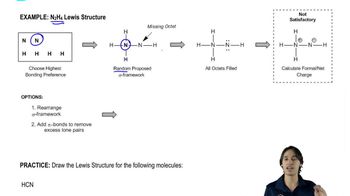
Lewis Structures

Lewis structures are diagrams that represent the bonding between atoms in a molecule and the lone pairs of electrons that may exist. They use dots to represent electrons and lines to represent bonds. Understanding how to draw Lewis structures is essential for visualizing molecular geometry and predicting reactivity.
Recommended video:
Guided course
04:12
Drawing the Lewis Structure for N2H4.

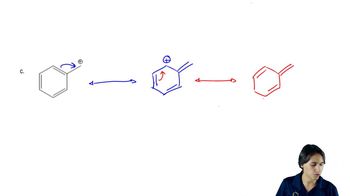
Resonance Structures

Resonance structures are different ways of drawing the same molecule that illustrate the delocalization of electrons. In molecules like azidomethane, resonance helps to depict the distribution of charge and the stability of the molecule. Recognizing resonance is crucial for understanding the actual electronic structure of a compound.
Recommended video:
Guided course
03:04
Drawing Resonance Structures

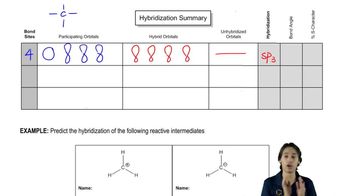
Hybridization

Hybridization is the concept of mixing atomic orbitals to form new hybrid orbitals that can accommodate bonding. In azidomethane, understanding the hybridization of the nitrogen atoms is important for predicting the geometry and bond angles in the molecule. This concept is key to grasping how atoms in a molecule interact and bond with each other.
Recommended video:
Guided course
10:43
Using bond sites to predict hybridization