Ch. 25 - Amines: Structure, Reactions, and Synthesis
Mullins - Organic Chemistry: A Learner Centered Approach 1st Edition
Mullins1st EditionOrganic Chemistry: A Learner Centered ApproachISBN: 9780137566471Not the one you use?Change textbook
Chapter 24, Problem 52

Despite the amino group being an ortho/para director, nitration of aniline gives the meta isomer predominantly. Explain this result.

Verified step by step guidance
1
Understand that the amino group (-NH2) is an ortho/para director due to its electron-donating nature, which typically increases electron density at the ortho and para positions of the benzene ring.
Recognize that nitration involves the introduction of a nitro group (-NO2) using a mixture of concentrated nitric acid (HNO3) and sulfuric acid (H2SO4), which generates the nitronium ion (NO2+), the active electrophile in the reaction.
Consider the reaction conditions: the strongly acidic environment protonates the amino group, converting it into an anilinium ion (-NH3+), which is a strong electron-withdrawing group.
Realize that the protonated amino group (-NH3+) is a meta director because it withdraws electron density from the ortho and para positions, making them less reactive towards electrophilic attack compared to the meta position.
Conclude that under these acidic conditions, the meta isomer is formed predominantly because the anilinium ion directs the incoming nitro group to the meta position, despite the original directing effects of the amino group.

Verified video answer for a similar problem:

This video solution was recommended by our tutors as helpful for the problem above.
Was this helpful?

Key Concepts

Here are the essential concepts you must grasp in order to answer the question correctly.

Amino Group as an Ortho/Para Director

The amino group (-NH2) is an electron-donating group that stabilizes the positive charge on the aromatic ring during electrophilic aromatic substitution. This stabilization occurs primarily at the ortho and para positions relative to the amino group, making these positions more reactive towards electrophiles like nitronium ions (NO2+).
Recommended video:
Guided course
04:42
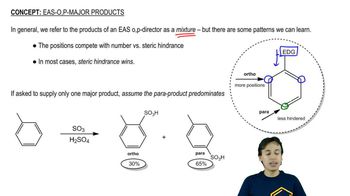
Ortho, Para major products

Electrophilic Aromatic Substitution Mechanism

Electrophilic aromatic substitution (EAS) is a fundamental reaction in organic chemistry where an electrophile replaces a hydrogen atom on an aromatic ring. In the case of aniline nitration, the nitronium ion generated from nitric acid and sulfuric acid acts as the electrophile. The reaction proceeds through the formation of a sigma complex, which can lead to different isomers depending on the stability of the intermediates.
Recommended video:
Guided course
06:52
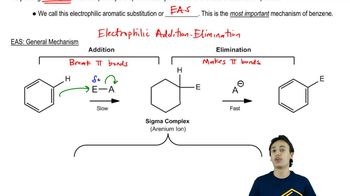
EAS General Mechanism

Steric Hindrance and Resonance Effects

While the amino group directs substitution to the ortho and para positions, steric hindrance can influence the outcome. In the case of aniline, the ortho position is hindered by the bulk of the amino group, making the meta position more favorable for substitution. Additionally, resonance effects can stabilize the meta product, leading to its predominance despite the ortho/para directing nature of the amino group.
Recommended video:
Guided course
02:53
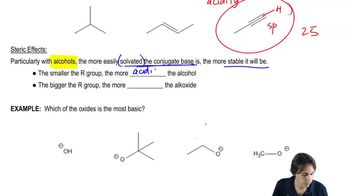
Understanding steric effects.