

A chemist attempted to oxidize a primary alcohol to a carboxylic acid using chromic acid. The product shown was obtained as a major component in the mixture. Suggest an arrow-pushing mechanism that accounts for its formation. [Think about what chromic acid would normally do to a phenol and make a list of bonds formed and bonds broken.]

Mullins 1st Edition
Ch. 24 - Benzene II: Reactions Influenced by the Aromatic Ring
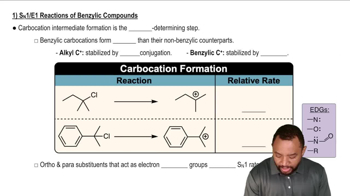
Problem 55Rationalize the ranking of increasing reaction rate of the benzylic halides shown.

Verified step by step guidance
Verified video answer for a similar problem:
Key Concepts
Benzylic Halides
Reaction Mechanisms
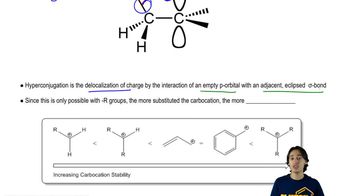
Carbocation Stability
Phenol oxidation can be coupled with other reactions to form new C―C bonds using reactions studied previously. Predict the product of the following series of reactions.
(a)
Identify the aromatic product that would result from the oxidation of the triol with an excess of PCC.
Phenol oxidation can be coupled with other reactions to form new C―C bonds using reactions studied previously. Predict the product of the following series of reactions.
(b)
Rationalize the fact that 1,4-dihydroxybenzene melts at a significantly higher temperature than 1,2-diydroxybenzene.
In light of your answers to Assessments 24.54 and 24.55, rank the following based on the rate of protonation of the alkene (1 = most basic, 6 = least basic). [Ignore the fact that the alkene may not be the most basic site in the molecule.]