
Ch. 23 - Benzene I: Aromatic Stability and Substitution Reactions
Mullins - Organic Chemistry: A Learner Centered Approach 1st Edition
Mullins1st EditionOrganic Chemistry: A Learner Centered ApproachISBN: 9780137566471Not the one you use?Change textbook
Chapter 22, Problem 81

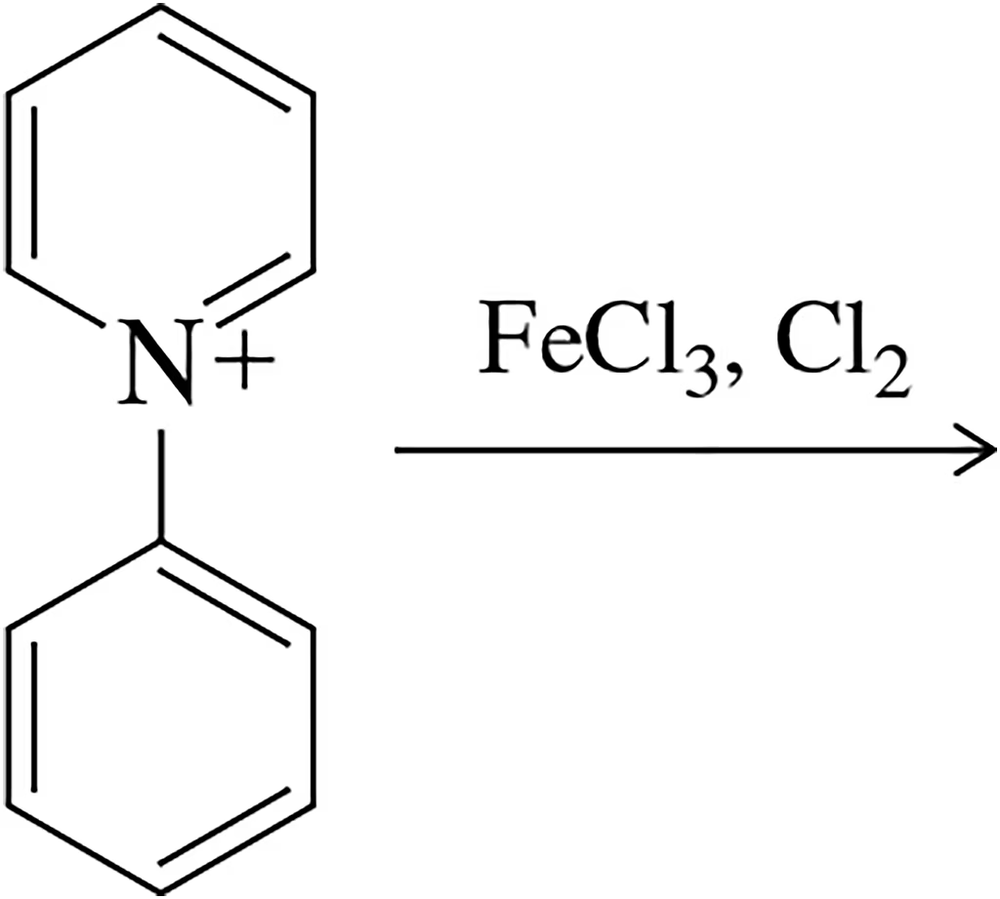
Would you expect chlorination to occur ortho, para, or meta to the pyridinium ion in the following molecule? Explain your answer.
Chemical structure of a pyridinium ion with a benzene ring, indicating chlorination conditions with reagents.

Verified step by step guidance
1
Identify the functional group in the molecule: The molecule contains a pyridinium ion, which is a pyridine ring with a positively charged nitrogen atom.
Understand the electronic effects: The pyridinium ion is an electron-withdrawing group due to the positive charge on the nitrogen, which decreases electron density on the aromatic ring.
Determine the directing effects: Electron-withdrawing groups typically direct electrophilic aromatic substitution reactions to the meta position relative to the group.
Consider the reaction conditions: The presence of FeCl3 and Cl2 indicates that this is a chlorination reaction, which is an electrophilic aromatic substitution.
Predict the site of chlorination: Based on the electron-withdrawing nature of the pyridinium ion, chlorination is expected to occur at the meta position relative to the pyridinium ion.

Verified video answer for a similar problem:

This video solution was recommended by our tutors as helpful for the problem above.
Was this helpful?

Key Concepts

Here are the essential concepts you must grasp in order to answer the question correctly.

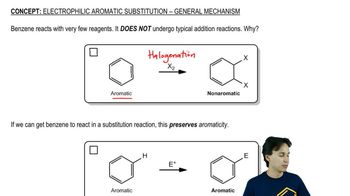
Electrophilic Aromatic Substitution (EAS)

Electrophilic Aromatic Substitution is a fundamental reaction in organic chemistry where an electrophile replaces a hydrogen atom on an aromatic ring. The reaction typically involves the formation of a sigma complex, where the aromaticity is temporarily lost, followed by deprotonation to restore aromaticity. Understanding EAS is crucial for predicting the positions where substitution will occur on the aromatic ring.
Recommended video:

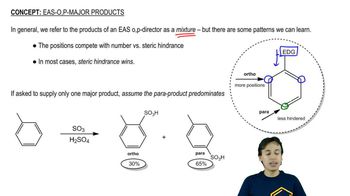
Ortho, Para, and Meta Positions

In the context of aromatic compounds, ortho, para, and meta refer to the relative positions of substituents on the benzene ring. Ortho positions are adjacent to each other, para positions are opposite each other, and meta positions are one carbon apart. The directing effects of substituents, such as electron-donating or electron-withdrawing groups, influence the likelihood of substitution occurring at these positions.
Recommended video:
Guided course
04:42
Ortho, Para major products

Pyridinium Ion and Its Effects

The pyridinium ion is a positively charged nitrogen-containing heterocycle that acts as an electron-withdrawing group due to the electronegativity of nitrogen. This property affects the reactivity of the aromatic ring it is attached to, typically directing electrophilic substitution to the meta position. Understanding the influence of the pyridinium ion is essential for predicting the outcome of chlorination in the given molecule.
Recommended video:
2:18
Metal Ion Catalysis Example 1