Ch. 23 - Benzene I: Aromatic Stability and Substitution Reactions
Mullins - Organic Chemistry: A Learner Centered Approach 1st Edition
Mullins1st EditionOrganic Chemistry: A Learner Centered ApproachISBN: 9780137566471Not the one you use?Change textbook
Chapter 22, Problem 56b

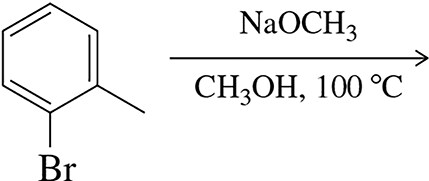
Predict the product(s) of the following nucleophilic aromatic substitution reactions occurring by the benzyne mechanism.
(b) Chemical structure of bromobenzene with sodium methoxide and methanol as reactants, indicating a nucleophilic substitution reaction.

Verified step by step guidance
1
Identify the substrate and the nucleophile: The substrate is a bromobenzene derivative with a methyl group ortho to the bromine. The nucleophile is methoxide ion (CH₃O⁻) in methanol.
Recognize the reaction conditions: The reaction is carried out at 100°C, which is conducive to the benzyne mechanism, a type of nucleophilic aromatic substitution.
Understand the benzyne mechanism: This mechanism involves the elimination of the leaving group (Br) to form a highly reactive benzyne intermediate. This occurs through the removal of a proton adjacent to the leaving group, forming a triple bond in the benzene ring.
Predict the formation of the benzyne intermediate: The base (NaOCH₃) abstracts a proton from the carbon adjacent to the bromine, resulting in the elimination of bromide ion and formation of the benzyne intermediate.
Determine the product formation: The methoxide ion can attack either carbon of the benzyne intermediate, leading to a mixture of products. The nucleophile adds to the benzyne, restoring aromaticity and forming a methoxy-substituted benzene.

Verified video answer for a similar problem:

This video solution was recommended by our tutors as helpful for the problem above.
Was this helpful?

Key Concepts

Here are the essential concepts you must grasp in order to answer the question correctly.

Nucleophilic Aromatic Substitution (NAS)

Nucleophilic aromatic substitution is a reaction where a nucleophile replaces a leaving group on an aromatic ring. This process typically occurs when the aromatic compound has electron-withdrawing groups that stabilize the negative charge developed during the reaction. The mechanism can proceed via different pathways, including the benzyne mechanism, which involves the formation of a highly reactive intermediate known as benzyne.
Recommended video:
Guided course
02:10
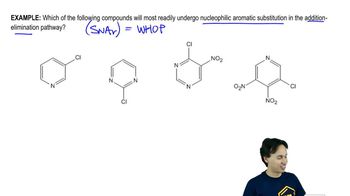
NAS in the addition-elimination pathway

Benzyne Mechanism

The benzyne mechanism is a specific pathway for nucleophilic aromatic substitution that involves the formation of a benzyne intermediate. This occurs when a leaving group, such as bromine, is eliminated to create a triple bond between two carbon atoms in the aromatic ring. The nucleophile then attacks this highly reactive intermediate, leading to the substitution product. This mechanism is particularly relevant when the aromatic compound lacks strong electron-withdrawing groups.
Recommended video:
Guided course
06:06
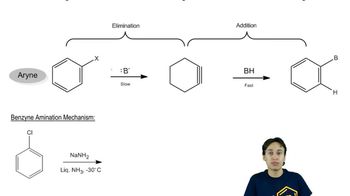
General Mechanism

Role of Sodium Methoxide and Methanol

Sodium methoxide (NaOCH3) acts as a strong nucleophile in the reaction, while methanol (CH3OH) serves as the solvent. The nucleophile attacks the benzyne intermediate formed during the reaction, facilitating the substitution process. The choice of methanol as a solvent is important as it can stabilize the reaction intermediates and help in the solvation of the nucleophile, enhancing the overall reaction efficiency.
Recommended video:
Guided course
03:19
Sodium Alkynide Alkylation