The zwitterionic form of carbonyls is often used to explain their electrophilicity. Draw the zwitterionic structure of NO+2. Why is this such a great electrophile at the central nitrogen?
Ch. 23 - Benzene I: Aromatic Stability and Substitution Reactions

Mullins1st EditionOrganic Chemistry: A Learner Centered ApproachISBN: 9780137566471Not the one you use?Change textbook
All textbooks
Mullins 1st Edition
Ch. 23 - Benzene I: Aromatic Stability and Substitution Reactions
Problem 32d
Mullins 1st Edition
Ch. 23 - Benzene I: Aromatic Stability and Substitution Reactions
Problem 32dChapter 22, Problem 32d
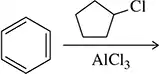
Predict the product of the following Friedel–Crafts alkylation reactions. Assume only one alkyl group adds in each case.
(d) 
Verified step by step guidance1
Identify the reactants: The reaction involves benzene and chlorocyclopentane in the presence of aluminum chloride (AlCl₃) as a catalyst.
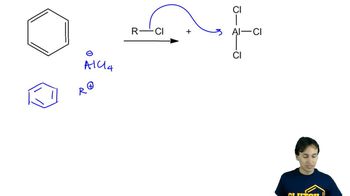
Understand the mechanism: Friedel-Crafts alkylation involves the formation of a carbocation intermediate. The chlorine atom in chlorocyclopentane will leave, forming a cyclopentyl carbocation.
Consider carbocation stability: The cyclopentyl carbocation is relatively stable and will act as the electrophile in the reaction.
Electrophilic aromatic substitution: The cyclopentyl carbocation will attack the benzene ring, forming a sigma complex (arenium ion) and eventually leading to the substitution of a hydrogen atom on the benzene ring with the cyclopentyl group.
Predict the product: The final product will be cyclopentylbenzene, where the cyclopentyl group is attached to the benzene ring.

Verified video answer for a similar problem:
This video solution was recommended by our tutors as helpful for the problem above.
Was this helpful?
Key Concepts
Here are the essential concepts you must grasp in order to answer the question correctly.
Friedel-Crafts Alkylation
Friedel-Crafts alkylation is a reaction that introduces an alkyl group into an aromatic ring using an alkyl halide and a Lewis acid catalyst, typically aluminum chloride (AlCl3). This electrophilic substitution reaction allows for the formation of new carbon-carbon bonds, enhancing the complexity of aromatic compounds. However, it can lead to polysubstitution and rearrangements, so careful control of conditions is necessary.
Recommended video:
Guided course
Friedel-Crafts Alkylation
Electrophilic Aromatic Substitution
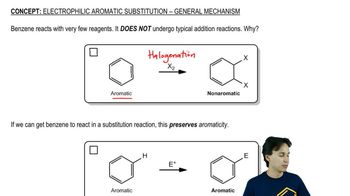
Electrophilic aromatic substitution (EAS) is a fundamental reaction mechanism in organic chemistry where an electrophile replaces a hydrogen atom on an aromatic ring. The aromatic system's electron-rich nature makes it susceptible to attack by electrophiles, leading to the formation of a sigma complex. This mechanism is crucial for understanding how substituents affect the reactivity and orientation of further substitutions on the aromatic ring.
Recommended video:
Guided course
EAS Review
Rearrangement of Carbocations
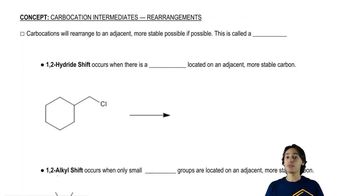
In Friedel-Crafts reactions, the formation of carbocations is a key step, and these intermediates can undergo rearrangement to form more stable structures. For instance, if a secondary or tertiary carbocation is formed, it may rearrange to a more stable tertiary carbocation before reacting with the aromatic ring. Understanding carbocation stability and rearrangement is essential for predicting the products of alkylation reactions.
Recommended video:
Guided course
Understanding why carbocations shift.
Related Practice
Textbook Question
1
views
Textbook Question
With a small electron-donating group on the ring, it is possible to get as much as a 2:1 ratio of ortho to para. Why might this be?
1
views
Textbook Question
Predict the product of the following Friedel–Crafts acylation reactions.
(b)
1
views
Textbook Question
In Section 23.7.4, we learned that Friedel–Crafts alkylation suffers from overalkylation.
(a) Draw the product of a Friedel–Crafts reaction that resulted in three methyl groups adding to the ring.
(b) Why is hard to stop at the addition of one alkyl group?
Textbook Question
Classify the following conjugated systems as having 4n or 4n + 2 π electrons.
(f)
1
views
Textbook Question
Convert the given name into the corresponding IUPAC name.
(b)
1
views