Ch. 23 - Benzene I: Aromatic Stability and Substitution Reactions
Mullins - Organic Chemistry: A Learner Centered Approach 1st Edition
Mullins1st EditionOrganic Chemistry: A Learner Centered ApproachISBN: 9780137566471Not the one you use?Change textbook
Chapter 22, Problem 26a

Name the following benzene derivatives using ortho, meta, and para to identify the relative position of substituents.
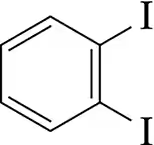
(a) Benzene ring with two iodine substituents, labeled for ortho, meta, and para positioning.

Verified step by step guidance
1
Identify the benzene ring as the parent structure in the compound.
Observe the substituents attached to the benzene ring. In this case, there are two iodine (I) atoms attached.
Determine the relative positions of the substituents on the benzene ring. The iodine atoms are adjacent to each other, which corresponds to the ortho position.
Use the ortho, meta, and para nomenclature to describe the positions of the substituents. Since the iodine atoms are in adjacent positions, the compound is named using 'ortho'.
Combine the information to name the compound as 'ortho-diiodobenzene', indicating the positions and the type of substituents on the benzene ring.

Verified video answer for a similar problem:

This video solution was recommended by our tutors as helpful for the problem above.
Was this helpful?

Key Concepts

Here are the essential concepts you must grasp in order to answer the question correctly.

Benzene Ring Structure

The benzene ring is a six-carbon cyclic structure with alternating double bonds, known as aromatic due to its stability and unique electron configuration. Each carbon atom in the ring is sp2 hybridized, allowing for a planar structure with delocalized π electrons above and below the ring, contributing to its chemical properties.
Recommended video:
Guided course
09:04
Benzene Nomenclature

Ortho, Meta, and Para Positions

In benzene derivatives, substituents can be positioned relative to each other as ortho (adjacent), meta (separated by one carbon), or para (opposite each other). These terms help describe the relative positions of groups on the benzene ring, which is crucial for naming and understanding the chemical behavior of the compound.
Recommended video:
Guided course
04:42
Ortho, Para major products

IUPAC Nomenclature for Aromatic Compounds

The IUPAC system provides a standardized way to name aromatic compounds, using prefixes like ortho, meta, and para to indicate the positions of substituents. For example, a benzene ring with two iodine atoms in adjacent positions is named ortho-diiodobenzene, reflecting the spatial arrangement of the substituents.
Recommended video:
Guided course
03:43
The different parts of an IUPAC name