Ch. 23 - Benzene I: Aromatic Stability and Substitution Reactions
Mullins - Organic Chemistry: A Learner Centered Approach 1st Edition
Mullins1st EditionOrganic Chemistry: A Learner Centered ApproachISBN: 9780137566471Not the one you use?Change textbook
Chapter 22, Problem 8

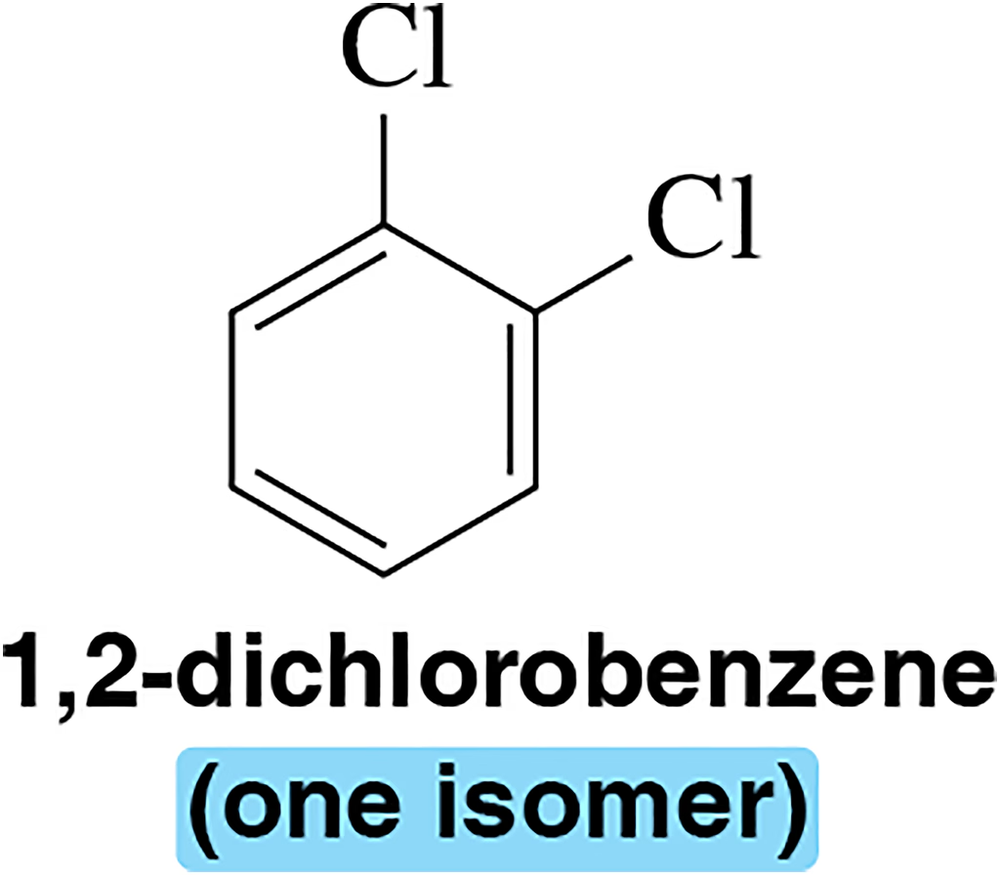
If Kekulé's original hypothesis had been correct and benzene was really an equilibrium between two structures, how many distinct isomers would exist for 1,2-dichlorobenzene?


Diagram of 1,2-dichlorobenzene showing two chlorine atoms on a benzene ring, labeled as one isomer.

Verified step by step guidance
1
Understand Kekulé's original hypothesis: Kekulé proposed that benzene is an equilibrium between two cyclohexatriene structures, where the double bonds alternate positions.
Consider the structure of 1,2-dichlorobenzene: In the given structure, two chlorine atoms are attached to adjacent carbon atoms in the benzene ring.
Analyze the effect of Kekulé's hypothesis: If benzene were an equilibrium between two structures, the position of the double bonds would change, potentially affecting the relative positions of substituents.
Determine the possible isomers: With alternating double bonds, the positions of the chlorine atoms could lead to different isomers depending on which double bond configuration is present at any given time.
Count the distinct isomers: Consider the different possible arrangements of the chlorine atoms with respect to the alternating double bonds to determine the number of distinct isomers.

Verified video answer for a similar problem:

This video solution was recommended by our tutors as helpful for the problem above.
Was this helpful?

Key Concepts

Here are the essential concepts you must grasp in order to answer the question correctly.

Kekulé Structure of Benzene

Friedrich August Kekulé proposed that benzene is a cyclic compound with alternating single and double bonds, leading to resonance structures. This model suggests that benzene can be represented as an equilibrium between two distinct structures, which influences the understanding of its reactivity and isomerism.
Recommended video:
Guided course
09:04
Benzene Nomenclature

Isomerism in Organic Chemistry

Isomerism refers to the phenomenon where compounds have the same molecular formula but different structural arrangements. In the case of 1,2-dichlorobenzene, the presence of two chlorine atoms on the benzene ring can lead to different spatial arrangements, resulting in distinct isomers such as ortho, meta, and para configurations.
Recommended video:
Guided course
00:56
What is an organic molecule?

Ortho, Meta, and Para Substitution

In aromatic compounds, substitution patterns are categorized as ortho (adjacent positions), meta (one carbon apart), and para (opposite positions). For 1,2-dichlorobenzene, the ortho isomer has both chlorines on adjacent carbons, while the para isomer has them on opposite sides, illustrating how substitution affects the properties and classification of isomers.
Recommended video:
Guided course
04:42
Ortho, Para major products