Ch. 23 - Benzene I: Aromatic Stability and Substitution Reactions
Mullins - Organic Chemistry: A Learner Centered Approach 1st Edition
Mullins1st EditionOrganic Chemistry: A Learner Centered ApproachISBN: 9780137566471Not the one you use?Change textbook
Chapter 22, Problem 61a

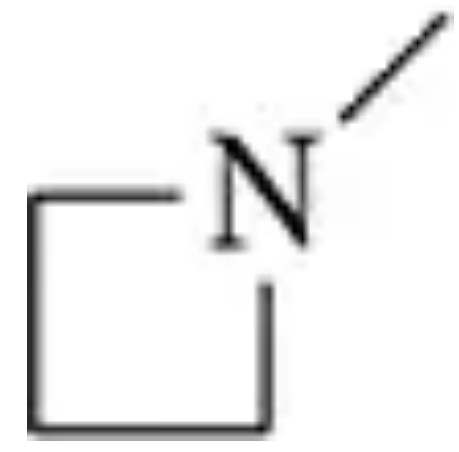
(i) Classify the following molecules as aromatic, nonaromatic, or antiaromatic.
(ii) For aromatic molecules, solve for n in Hückel’s rule. For all other molecules, explain which rule of aromaticity is being broken.
(a) Chemical structure of a nitrogen atom bonded to a carbon atom, illustrating concepts of aromaticity in organic chemistry.

Verified step by step guidance
1
Identify the structure: The image shows a four-membered ring with a nitrogen atom, which is a cyclobutadiene with a nitrogen atom replacing one of the carbon atoms.
Determine the number of π-electrons: In this structure, there are two π-electrons from the double bond.
Apply Hückel's rule: Aromatic compounds must have (4n + 2) π-electrons, where n is a non-negative integer. Check if 2 fits this formula.
Check planarity and conjugation: For a molecule to be aromatic, it must be planar and fully conjugated. Cyclobutadiene is planar and conjugated.
Classify the molecule: Since the molecule has 4 π-electrons, which fits the 4n rule (n=1), it is antiaromatic. Anti-aromatic compounds are planar, cyclic, and have 4n π-electrons.

Verified video answer for a similar problem:

This video solution was recommended by our tutors as helpful for the problem above.
Video duration:
2m
Was this helpful?

Key Concepts

Here are the essential concepts you must grasp in order to answer the question correctly.

Aromaticity

Aromaticity refers to a property of cyclic compounds that exhibit enhanced stability due to the delocalization of π electrons across the ring structure. For a molecule to be classified as aromatic, it must be cyclic, planar, fully conjugated, and follow Hückel's rule, which states that the number of π electrons must equal 4n + 2, where n is a non-negative integer.
Recommended video:
Guided course
08:19
Intro to Aromaticity

Hückel's Rule

Hückel's rule is a criterion used to determine the aromaticity of a compound. It states that a planar, cyclic molecule is aromatic if it contains 4n + 2 π electrons in its conjugated system. This rule helps in identifying aromatic compounds by calculating the total number of π electrons and checking if it fits the formula, thus providing a quantitative measure of aromatic stability.
Recommended video:
Guided course
03:54
The 18 and 16 Electron Rule

Anti-aromaticity

Anti-aromaticity is a property of cyclic compounds that leads to instability due to the presence of 4n π electrons, which is contrary to Hückel's rule. Such compounds are typically less stable than their non-aromatic counterparts because the electron delocalization does not confer the same level of stabilization. Identifying anti-aromatic compounds involves recognizing the cyclic structure and counting the π electrons to see if they fit the 4n pattern.
Recommended video:
Guided course
08:19
Intro to Aromaticity