Ch. 23 - Benzene I: Aromatic Stability and Substitution Reactions
Mullins - Organic Chemistry: A Learner Centered Approach 1st Edition
Mullins1st EditionOrganic Chemistry: A Learner Centered ApproachISBN: 9780137566471Not the one you use?Change textbook
Chapter 22, Problem 64

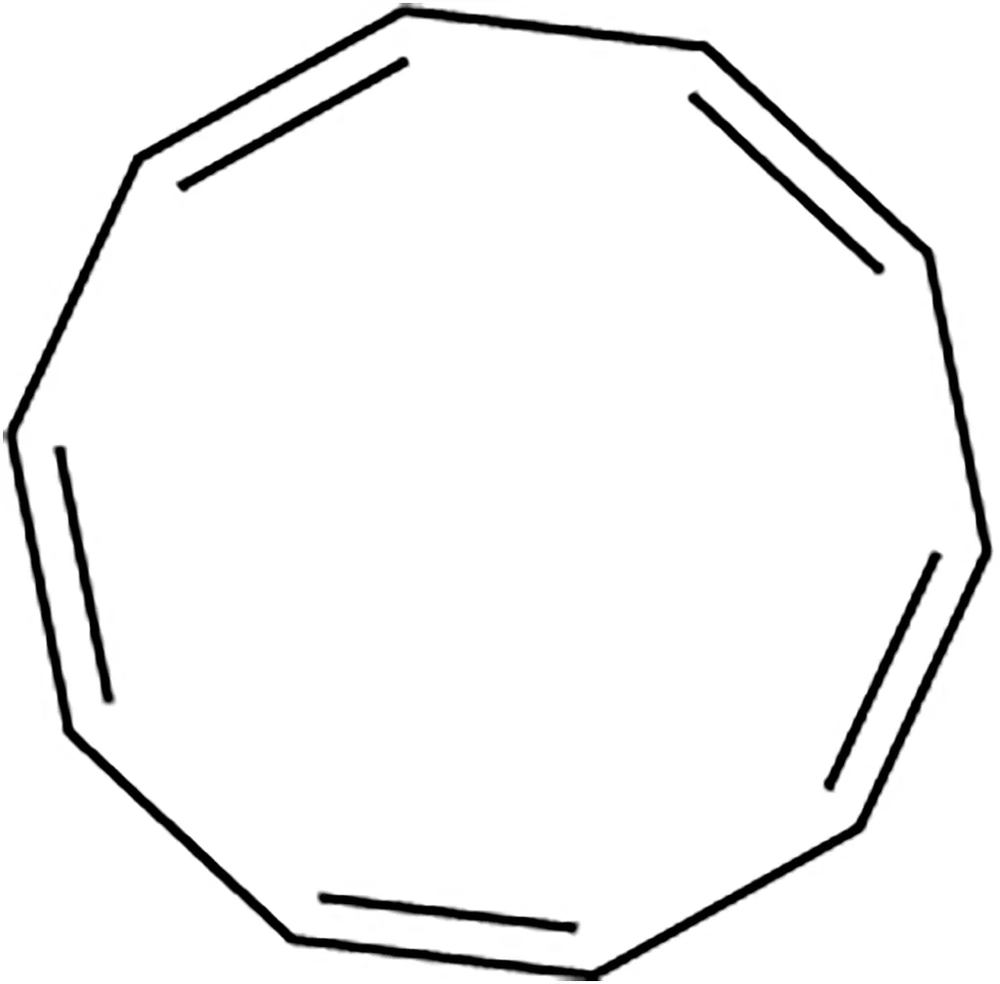
Despite having only sp2-hybridized carbons and having 10 electrons (4n + 2) , the annulene shown is not aromatic. Why?
Chemical structure of annulene, a cyclic compound with alternating double bonds, not exhibiting aromaticity despite 10 π electrons.

Verified step by step guidance
1
Identify the structure shown in the image as a 10-membered annulene, which is a cyclic hydrocarbon with alternating single and double bonds.
Recall the criteria for aromaticity: a molecule must be cyclic, planar, fully conjugated, and follow Huckel's rule (4n + 2) π electrons, where n is a non-negative integer.
Verify that the molecule has 10 π electrons, which satisfies Huckel's rule for n=2 (4n + 2 = 10).
Assess the planarity of the molecule. For a molecule to be aromatic, it must be planar to allow for the delocalization of π electrons across the ring.
Consider the size and strain of the 10-membered ring. Larger rings like this one often have difficulty maintaining planarity due to steric strain and flexibility, which can prevent effective π electron delocalization, thus making the molecule non-aromatic.

Verified video answer for a similar problem:

This video solution was recommended by our tutors as helpful for the problem above.
Video duration:
3m
Was this helpful?

Key Concepts

Here are the essential concepts you must grasp in order to answer the question correctly.

Aromaticity

Aromaticity is a property of cyclic compounds that exhibit enhanced stability due to delocalized π electrons. For a compound to be aromatic, it must be cyclic, planar, and follow Hückel's rule, which states that it should have 4n + 2 π electrons, where n is a non-negative integer. This delocalization allows for resonance, contributing to the compound's stability.
Recommended video:
Guided course
08:19
Intro to Aromaticity

Hückel's Rule

Hückel's rule is a criterion used to determine the aromaticity of a compound based on its π electron count. According to this rule, a planar, cyclic molecule is aromatic if it contains 4n + 2 π electrons. This means that while a compound may have the correct number of π electrons, other structural factors must also be considered to confirm its aromatic nature.
Recommended video:
Guided course
03:54
The 18 and 16 Electron Rule

Planarity and Hybridization

Planarity refers to the arrangement of atoms in a molecule such that all atoms lie in the same geometric plane, which is crucial for effective overlap of p orbitals in aromatic compounds. In the case of sp²-hybridized carbons, each carbon atom contributes one unhybridized p orbital for π bonding. If the molecule is not fully planar, even with the correct number of π electrons, it may not exhibit aromaticity.
Recommended video:
Guided course
10:43
Using bond sites to predict hybridization