Ch. 22 - Conjugated Systems II: Pericyclic Reactions
Mullins - Organic Chemistry: A Learner Centered Approach 1st Edition
Mullins1st EditionOrganic Chemistry: A Learner Centered ApproachISBN: 9780137566471Not the one you use?Change textbook
Chapter 21, Problem 26

What stereochemical result would you expect if the Diels–Alder reaction with the free α,β- unsaturated ketone was faster than reaction with the iminium-bound alkene?

Verified step by step guidance
1
Understand the Diels-Alder reaction: It is a [4+2] cycloaddition reaction between a conjugated diene and a dienophile, typically forming a six-membered ring. The stereochemistry of the product is influenced by the orientation of the substituents on the diene and dienophile.
Identify the reactants: In this problem, we have an α,β-unsaturated ketone as the dienophile. The free α,β-unsaturated ketone can participate in the Diels-Alder reaction without any steric hindrance from other groups.
Consider the stereochemical outcome: The Diels-Alder reaction is stereospecific, meaning that the stereochemistry of the reactants will dictate the stereochemistry of the product. The reaction with the free α,β-unsaturated ketone will likely proceed with the formation of a product where substituents are oriented according to the endo rule, which favors the formation of the more stable transition state.
Compare with iminium-bound alkene: If the reaction with the free α,β-unsaturated ketone is faster, it suggests that the steric or electronic effects of the iminium-bound alkene are less favorable for the Diels-Alder reaction. The iminium ion can impose steric hindrance or electronic effects that slow down the reaction.
Predict the stereochemical result: Given that the free α,β-unsaturated ketone reacts faster, the stereochemical result will likely be dictated by the orientation of substituents in the free ketone, following the endo preference, leading to a specific stereochemical configuration in the product.

Key Concepts

Here are the essential concepts you must grasp in order to answer the question correctly.

Diels–Alder Reaction

The Diels–Alder reaction is a [4+2] cycloaddition between a conjugated diene and a dienophile, forming a six-membered ring. It is stereospecific, often preserving the stereochemistry of the reactants, and can be influenced by electronic and steric factors. Understanding the reaction's mechanism is crucial for predicting the stereochemical outcome.
Recommended video:
Guided course
04:02
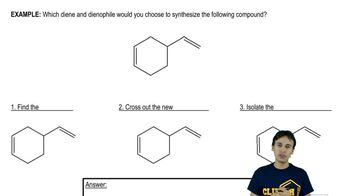
Diels-Alder Retrosynthesis

Stereochemistry

Stereochemistry involves the study of spatial arrangement of atoms in molecules and its impact on chemical reactions. In the context of the Diels–Alder reaction, stereochemistry determines the configuration of the newly formed ring, influenced by the orientation of substituents on the diene and dienophile. Recognizing how stereochemistry affects reaction pathways is essential for predicting products.
Recommended video:
1:38
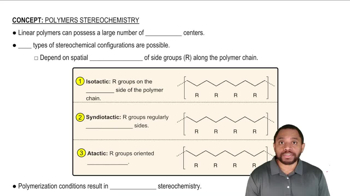
Polymer Stereochemistry Concept 1

Iminium Ion Chemistry

Iminium ions are reactive intermediates formed by the condensation of amines with carbonyl compounds. They can act as electrophiles in reactions, altering the reactivity and selectivity of alkenes. In the Diels–Alder context, comparing the reactivity of iminium-bound alkenes versus free alkenes helps determine which pathway is favored, impacting the stereochemical outcome.
Recommended video:
3:39
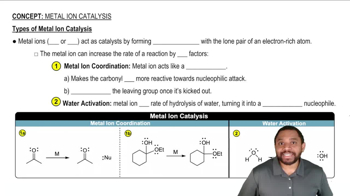
Metal Ion Catalysis Concept 1