Ch. 22 - Conjugated Systems II: Pericyclic Reactions
Mullins - Organic Chemistry: A Learner Centered Approach 1st Edition
Mullins1st EditionOrganic Chemistry: A Learner Centered ApproachISBN: 9780137566471Not the one you use?Change textbook
Chapter 21, Problem 7c

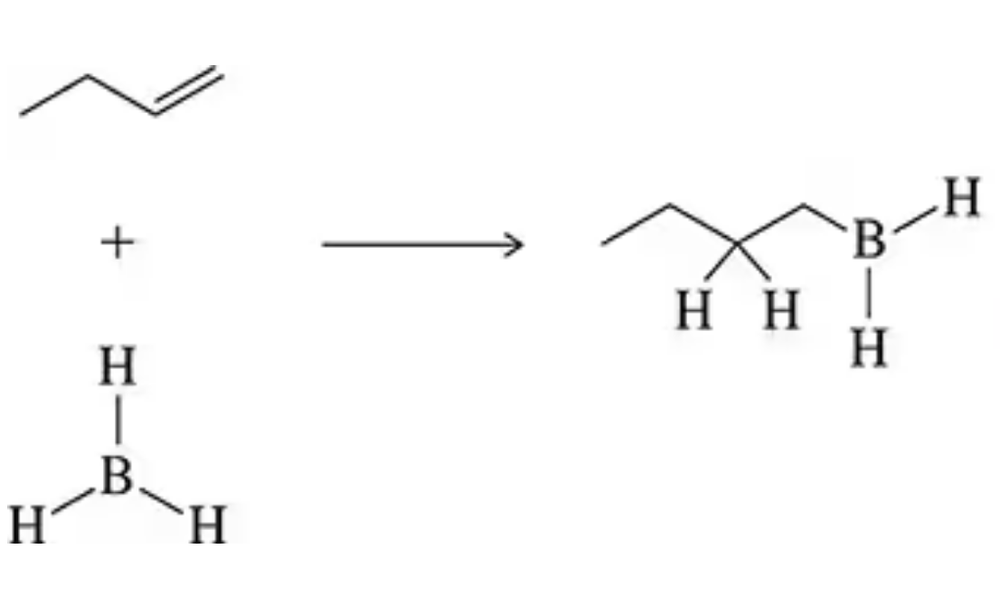
We have studied a number of pericyclic reactions previously. Draw the mechanism of the steps shown. The section number where this material was first studied is given for your review.
(c) Chemical reaction diagram illustrating hydroboration with reactants and product structures.

Verified step by step guidance
1
Step 1: Identify the type of pericyclic reaction involved. Based on the reactants and products, this appears to be a hydroboration reaction, which is a type of concerted addition reaction where boron adds to the less substituted carbon of an alkene.
Step 2: Analyze the reactants. The alkene (CH2=CH-CH2CH3) is the electron-rich species, and the borane (BH3) is the electron-deficient species. The reaction proceeds via a cyclic transition state.
Step 3: Draw the mechanism. In the hydroboration step, the π-electrons of the alkene interact with the empty p-orbital of boron, while one of the B-H bonds simultaneously donates a proton to the more substituted carbon. This results in syn addition of boron and hydrogen across the double bond.
Step 4: Show the product formation. The boron atom attaches to the less substituted carbon (CH2 group), and the hydrogen attaches to the more substituted carbon (CH group). This regioselectivity is due to steric and electronic factors.
Step 5: Review the stereochemistry. The addition of boron and hydrogen occurs in a syn fashion, meaning both groups are added to the same face of the alkene. This stereochemical outcome is consistent with the concerted nature of the reaction.

Verified video answer for a similar problem:

This video solution was recommended by our tutors as helpful for the problem above.
Was this helpful?

Key Concepts

Here are the essential concepts you must grasp in order to answer the question correctly.

Pericyclic Reactions

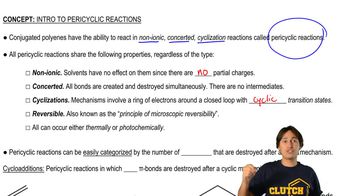
Pericyclic reactions are a class of organic reactions that occur through a concerted mechanism, involving a cyclic transition state. These reactions often involve the rearrangement of electrons in a way that conserves orbital symmetry, allowing for the formation of new bonds without the need for intermediates. Common types include cycloadditions, electrocyclic reactions, and sigmatropic rearrangements.
Recommended video:
Guided course
07:37
Properties and Types of Pericyclic Reactions

Hydroboration

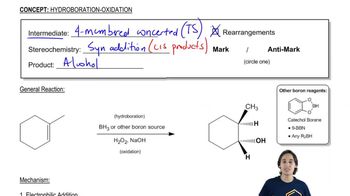
Hydroboration is a chemical reaction that involves the addition of borane (BH3) to alkenes, resulting in the formation of organoboranes. This reaction proceeds via a concerted mechanism, where the boron atom adds to the less substituted carbon of the alkene, leading to syn-addition. Hydroboration is often followed by oxidation to yield alcohols, making it a valuable method for synthesizing alcohols from alkenes.
Recommended video:
Guided course
06:38
General properties of hydroboration-oxidation.

Mechanism of Reactions

The mechanism of a chemical reaction describes the step-by-step process by which reactants are converted into products. It includes details about bond breaking and forming, the movement of electrons, and the role of intermediates. Understanding the mechanism is crucial for predicting the outcome of reactions, optimizing conditions, and designing new synthetic pathways in organic chemistry.
Recommended video:
Guided course
02:16
Heck Reaction Mechanism