Ch. 22 - Conjugated Systems II: Pericyclic Reactions
Mullins - Organic Chemistry: A Learner Centered Approach 1st Edition
Mullins1st EditionOrganic Chemistry: A Learner Centered ApproachISBN: 9780137566471Not the one you use?Change textbook
Chapter 21, Problem 18d

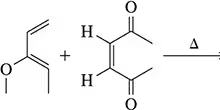
Predict the product of the following Diels–Alder reactions. Where a racemic mixture is produced, show both enantiomers and explain how each is formed.
(d) Diels-Alder reaction between a diene and a dienophile, showing reactants and reaction conditions.

Verified step by step guidance
1
Identify the diene and dienophile in the given reaction. The diene is typically a conjugated system with two double bonds, and the dienophile is an alkene or alkyne that will react with the diene.
Consider the stereochemistry of the diene and dienophile. The Diels–Alder reaction is stereospecific, meaning that the stereochemistry of the reactants will influence the stereochemistry of the product.
Draw the transition state of the Diels–Alder reaction. This involves a cyclic structure where the diene and dienophile are approaching each other to form a new six-membered ring.
Predict the product by forming a new six-membered ring. The newly formed ring will have two new single bonds where the diene and dienophile were previously double bonds. Consider the stereochemistry: if the dienophile is substituted, the substituents will be oriented according to the endo or exo rule.
If a racemic mixture is produced, draw both enantiomers. Enantiomers are non-superimposable mirror images, and they arise when the product has chiral centers. Explain how each enantiomer is formed based on the orientation of substituents in the transition state.

Verified video answer for a similar problem:

This video solution was recommended by our tutors as helpful for the problem above.
Video duration:
10m
Was this helpful?

Key Concepts

Here are the essential concepts you must grasp in order to answer the question correctly.

Diels–Alder Reaction

The Diels–Alder reaction is a [4+2] cycloaddition reaction between a conjugated diene and a dienophile, resulting in the formation of a six-membered ring. This reaction is stereospecific, meaning the stereochemistry of the reactants influences the stereochemistry of the product. It is a concerted process, occurring in a single step without intermediates, and is widely used in organic synthesis to construct complex cyclic structures.
Recommended video:
Guided course
04:02
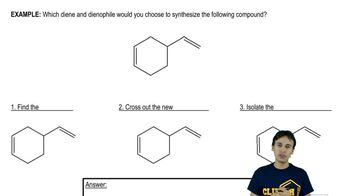
Diels-Alder Retrosynthesis

Stereochemistry in Diels–Alder Reactions

Stereochemistry plays a crucial role in Diels–Alder reactions, as the configuration of the diene and dienophile determines the stereochemistry of the product. The reaction can produce enantiomers if the dienophile or diene is chiral or if the reaction occurs in a chiral environment. The endo rule often guides the stereochemical outcome, favoring the formation of the endo product, where substituents on the dienophile are oriented towards the diene's π system.
Recommended video:
Guided course
04:02
Diels-Alder Retrosynthesis

Racemic Mixture

A racemic mixture is an equimolar mixture of two enantiomers, which are non-superimposable mirror images of each other. In the context of the Diels–Alder reaction, a racemic mixture is formed when the reaction produces both enantiomers of a chiral product. This occurs when the reaction environment is achiral, allowing both enantiomers to form with equal probability, resulting in a mixture that is optically inactive.
Recommended video:
Guided course
03:08
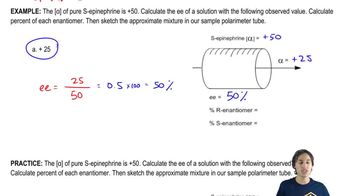
Calculating EE, percent of each enantiomer, and sketching mixture