Ch. 22 - Conjugated Systems II: Pericyclic Reactions
Mullins - Organic Chemistry: A Learner Centered Approach 1st Edition
Mullins1st EditionOrganic Chemistry: A Learner Centered ApproachISBN: 9780137566471Not the one you use?Change textbook
Chapter 21, Problem 36a

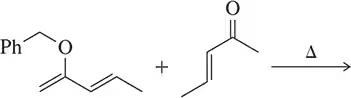
Predict the product of the Diels–Alder reactions shown.
(a) Diels-Alder reaction between a phenyl-substituted diene and a dienophile with a ketone group, under heat.

Verified step by step guidance
1
Identify the diene and the dienophile in the reaction. The diene is a conjugated system with two double bonds, and the dienophile is typically an alkene or alkyne with electron-withdrawing groups.
Ensure the diene is in the s-cis conformation, which is necessary for the Diels-Alder reaction to occur. If it is not, consider any possible rotations or conformational changes.
Align the diene and dienophile so that the p orbitals can overlap effectively. This involves bringing the diene and dienophile close together in a way that allows for the formation of new sigma bonds.
Draw the transition state of the reaction, showing the cyclic overlap of the p orbitals. This is a concerted process where bonds are broken and formed simultaneously.
Predict the product by forming a six-membered ring. The new sigma bonds form between the ends of the diene and the dienophile, resulting in a cyclohexene derivative. Consider any stereochemistry involved, as the reaction is stereospecific.

Verified video answer for a similar problem:

This video solution was recommended by our tutors as helpful for the problem above.
Video duration:
9m
Was this helpful?

Key Concepts

Here are the essential concepts you must grasp in order to answer the question correctly.

Diels–Alder Reaction

The Diels–Alder reaction is a [4+2] cycloaddition between a conjugated diene and a dienophile, typically forming a six-membered ring. It is a pericyclic reaction that proceeds via a concerted mechanism, meaning bonds are formed simultaneously without intermediates. This reaction is stereospecific, often preserving the stereochemistry of the reactants in the product.
Recommended video:
Guided course
04:02
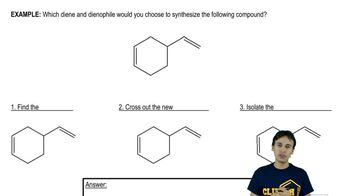
Diels-Alder Retrosynthesis

Conjugated Diene

A conjugated diene consists of two double bonds separated by a single bond, allowing for electron delocalization across the π-system. This delocalization stabilizes the diene and makes it reactive in cycloaddition reactions like the Diels–Alder. The s-cis conformation of the diene is crucial for effective overlap with the dienophile's π-orbitals during the reaction.
Recommended video:
Guided course
03:27
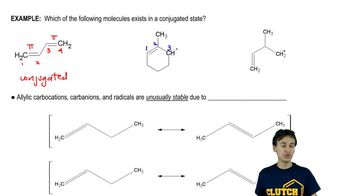
Conjugated states

Dienophile

A dienophile is an alkene or alkyne that reacts with a diene in the Diels–Alder reaction. It typically contains electron-withdrawing groups that enhance its reactivity by making the π-bond more electrophilic. The stereochemistry of the dienophile influences the stereochemistry of the resulting cyclohexene product, making its orientation important in predicting the reaction outcome.
Recommended video:
Guided course
09:48
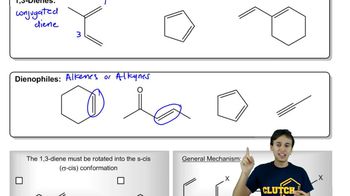
General Features