
Ch. 22 - Conjugated Systems II: Pericyclic Reactions
Mullins - Organic Chemistry: A Learner Centered Approach 1st Edition
Mullins1st EditionOrganic Chemistry: A Learner Centered ApproachISBN: 9780137566471Not the one you use?Change textbook
Chapter 21, Problem 46

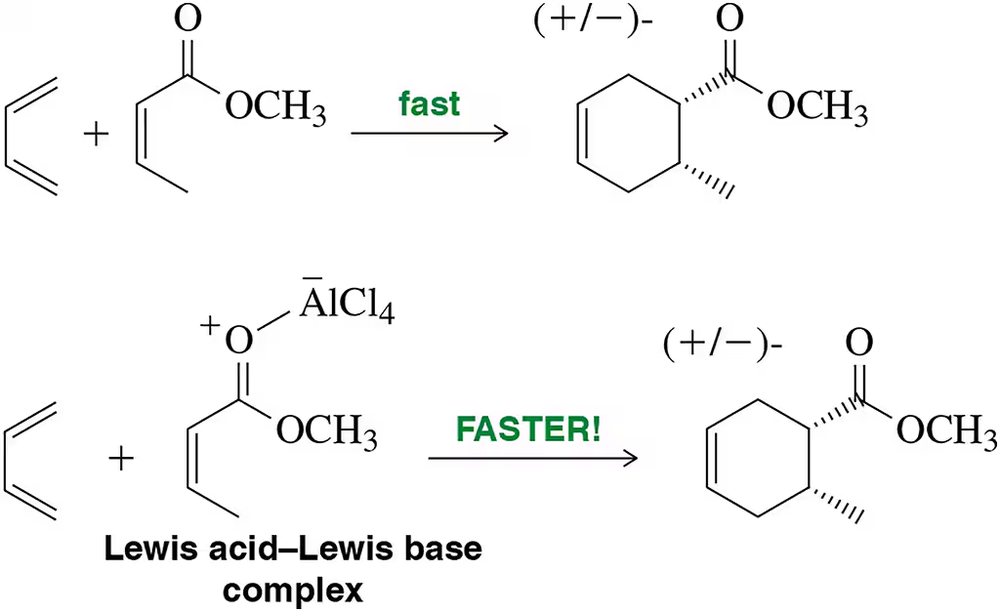
By forming a Lewis acid–Lewis base complex with the dienophile, Lewis acids are able to increase the rate of Diels–Alder reactions. Why might this be true?
Diagram comparing Diels-Alder reaction rates with and without a Lewis acid–Lewis base complex, highlighting "fast" and "FASTER!" reactions.

Verified step by step guidance
1
The Diels–Alder reaction involves a diene and a dienophile. In the image, the dienophile is a compound with a carbonyl group, which can act as a Lewis base due to the lone pair of electrons on the oxygen atom.
Lewis acids, such as AlCl₃, can accept electron pairs. When the Lewis acid forms a complex with the dienophile, it interacts with the lone pair on the oxygen, making the carbonyl carbon more electrophilic.
By increasing the electrophilicity of the dienophile, the Lewis acid facilitates the approach and reaction with the diene, thereby increasing the rate of the Diels–Alder reaction.
The image shows that the reaction proceeds faster when the Lewis acid is present, indicating that the formation of the Lewis acid–Lewis base complex enhances the reaction rate.
Overall, the Lewis acid–Lewis base interaction lowers the activation energy required for the reaction, making the process more efficient and faster.

Verified video answer for a similar problem:

This video solution was recommended by our tutors as helpful for the problem above.
Was this helpful?

Key Concepts

Here are the essential concepts you must grasp in order to answer the question correctly.

Diels–Alder Reaction

The Diels–Alder reaction is a [4+2] cycloaddition reaction between a conjugated diene and a dienophile, forming a six-membered ring. It is a pericyclic reaction that proceeds through a concerted mechanism, meaning bonds are formed and broken simultaneously. This reaction is stereospecific and can be influenced by electronic and steric factors, making it a valuable tool in synthetic organic chemistry.
Recommended video:
Guided course
04:02
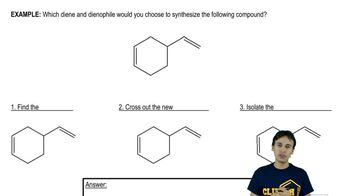
Diels-Alder Retrosynthesis

Lewis Acids and Bases

Lewis acids are chemical species that can accept an electron pair, while Lewis bases donate an electron pair. In the context of the Diels–Alder reaction, a Lewis acid can coordinate with the dienophile, increasing its electrophilicity. This interaction can lower the activation energy of the reaction, thereby increasing the reaction rate, as seen in the provided image where AlCl4- acts as a Lewis acid.
Recommended video:
Guided course
02:49
The Lewis definition of acids and bases.

Activation Energy and Reaction Rate

Activation energy is the minimum energy required for a chemical reaction to occur. Lowering the activation energy increases the reaction rate, as more molecules have sufficient energy to react. In the Diels–Alder reaction, the formation of a Lewis acid–Lewis base complex with the dienophile reduces the activation energy, thus accelerating the reaction, as illustrated by the 'FASTER!' label in the image.
Recommended video:
2:29
Rates of Intramolecular Reactions Concept 1
Related Practice
Textbook Question

The [2 + 2] cyclization is especially useful when done intramolecularly. 

(a) What makes intramolecular reactions more favorable? 

(b) Predict the product of the following cyclization (slight modification of a reaction from Angew. Chem. 2011, 50, 5149)

3
views
Textbook Question

Predict the product of the following reactions. [When all of the reactions from this chapter are shown together, you must first decide which type of reaction each is. Is it a Diels–Alder, an electrocyclic, or a sigmatropic rearrangement? Drawing the product will be easier once this determination is made.]

(b)

1
views
Textbook Question

Suggest a diene and a dienophile that would give the following products.

(c)

1
views
Textbook Question

The Claisen rearrangement can be used to attach allyl groups to benzene via initial alkylation of a phenol.

(a) Predict the identity of A and B

(b) provide an arrow-pushing mechanism for each step. [The phenol alkylation is simply a Williamson ether synthesis reaction.]


1
views
Textbook Question

Predict the product of the following reactions. [When all of the reactions from this chapter are shown together, you must first decide which type of reaction each is. Is it a Diels–Alder, an electrocyclic, or a sigmatropic rearrangement? Drawing the product will be easier once this determination is made.]

(a)

2
views
Textbook Question

The Ireland–Claisen reaction is a variant of the Claisen reaction studied in this chapter.

(a) Suggest a mechanism for the first step.

(b) Predict the product (B) that would result from heating intermediate A.

(c) Hydrolysis of B gives a carboxylic acid.

Suggest a mechanism for this reaction.

1
views