Ch. 21 - Conjugated Systems I: Stability and Addition Reactions
Mullins - Organic Chemistry: A Learner Centered Approach 1st Edition
Mullins1st EditionOrganic Chemistry: A Learner Centered ApproachISBN: 9780137566471Not the one you use?Change textbook
Chapter 20, Problem 44

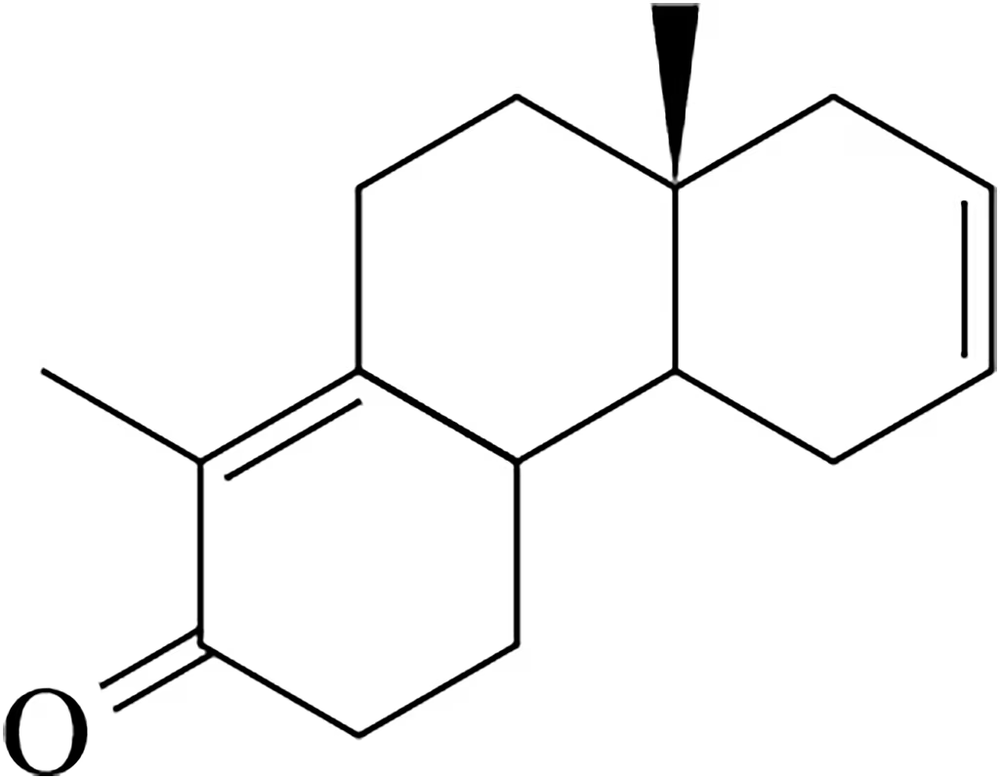
Show how the following molecule might be synthesized using the Robinson annulation.
Chemical structure of a molecule illustrating synthesis via Robinson annulation, featuring hexagonal rings and functional groups.

Verified step by step guidance
1
Identify the target molecule as a bicyclic compound with a ketone and an alpha-beta unsaturated system, which is a typical product of a Robinson annulation.
Recognize that Robinson annulation involves a Michael addition followed by an intramolecular aldol condensation. The starting materials are typically a ketone and an alpha, beta-unsaturated carbonyl compound.
Select a suitable alpha, beta-unsaturated carbonyl compound, such as methyl vinyl ketone, which will participate in the Michael addition.
Choose a suitable ketone that can form the enolate ion needed for the Michael addition. In this case, cyclohexanone can be used as it can form an enolate that will add to the methyl vinyl ketone.
Perform the Robinson annulation: First, generate the enolate from cyclohexanone using a base. Then, carry out the Michael addition with methyl vinyl ketone. Finally, perform an intramolecular aldol condensation to form the second ring and complete the synthesis of the target molecule.

Verified video answer for a similar problem:

This video solution was recommended by our tutors as helpful for the problem above.
Video duration:
8m
Was this helpful?

Key Concepts

Here are the essential concepts you must grasp in order to answer the question correctly.

Robinson Annulation

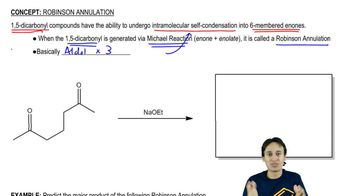
The Robinson annulation is a key reaction in organic chemistry that involves the formation of a six-membered ring through the condensation of a ketone with a cyclic enone. This reaction typically consists of two main steps: an initial Michael addition followed by an intramolecular aldol condensation. Understanding this process is crucial for synthesizing complex molecules, as it allows for the construction of cyclic structures that are prevalent in natural products.
Recommended video:
Guided course
04:12
Robinson Annulation

Michael Addition

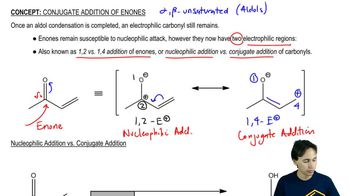
Michael addition is a fundamental reaction in organic chemistry where a nucleophile adds to an α,β-unsaturated carbonyl compound. This step is essential in the Robinson annulation, as it forms a new carbon-carbon bond, setting the stage for the subsequent cyclization. Recognizing the role of nucleophiles and electrophiles in this reaction helps in predicting the outcome of the synthesis.
Recommended video:
Guided course
09:23
1,2 vs 1,4 Addition

Aldol Condensation

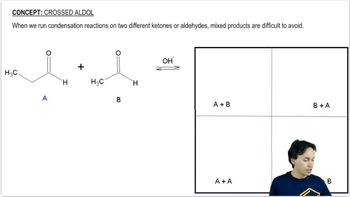
Aldol condensation is a reaction between aldehydes or ketones that leads to the formation of β-hydroxy carbonyl compounds, which can further dehydrate to form α,β-unsaturated carbonyl compounds. In the context of the Robinson annulation, this step is crucial for closing the ring and completing the synthesis of the desired cyclic structure. Understanding the conditions that favor aldol condensation, such as the presence of a base, is vital for successful synthesis.
Recommended video:
Guided course
09:51
Crossed Aldol