Ch. 21 - Conjugated Systems I: Stability and Addition Reactions
Mullins - Organic Chemistry: A Learner Centered Approach 1st Edition
Mullins1st EditionOrganic Chemistry: A Learner Centered ApproachISBN: 9780137566471Not the one you use?Change textbook
Chapter 20, Problem 57i

Predict the product of the following reactions.
(i) Chemical reaction showing a ketone with a methoxy group reacting with Me2CuLi in THF, followed by H3O+ quench.

Verified step by step guidance
1
Identify the type of reaction taking place. Common types include addition, elimination, substitution, and rearrangement reactions. Understanding the reaction type will guide you in predicting the product.
Examine the reactants involved in the reaction. Look for functional groups, stereochemistry, and any other relevant structural features that might influence the reaction pathway.
Consider the reaction conditions provided, such as temperature, solvent, and catalysts. These conditions can significantly affect the mechanism and outcome of the reaction.
Apply the appropriate reaction mechanism based on the type of reaction and the reactants involved. For example, if it's an addition reaction, determine if it follows Markovnikov or anti-Markovnikov rules.
Draw the structure of the predicted product, ensuring that you account for any changes in stereochemistry, regiochemistry, or functional groups as dictated by the reaction mechanism.

Verified video answer for a similar problem:

This video solution was recommended by our tutors as helpful for the problem above.
Video duration:
1m
Was this helpful?

Key Concepts

Here are the essential concepts you must grasp in order to answer the question correctly.

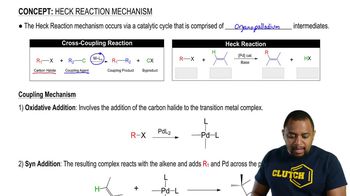
Reaction Mechanism

A reaction mechanism outlines the step-by-step process by which reactants transform into products. Understanding the mechanism is crucial for predicting the outcome of a reaction, as it involves identifying intermediates, transition states, and the movement of electrons. This concept helps in visualizing how bonds are broken and formed during the reaction.
Recommended video:
Guided course
02:16
Heck Reaction Mechanism

Functional Groups

Functional groups are specific groups of atoms within molecules that are responsible for the characteristic chemical reactions of those molecules. Recognizing these groups is essential for predicting reaction products, as they often dictate the reactivity and interaction of molecules. Common examples include hydroxyl, carbonyl, and amino groups.
Recommended video:
Guided course
02:36
Identifying Functional Groups

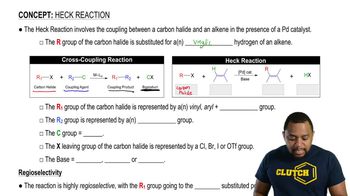
Regioselectivity and Stereoselectivity

Regioselectivity refers to the preference of a chemical reaction to occur at one direction or position over others, while stereoselectivity involves the formation of a specific stereoisomer when multiple are possible. These concepts are vital for predicting the major product of a reaction, as they determine the orientation and arrangement of atoms in the final structure.
Recommended video:
Guided course
05:09
Heck Reaction