Ch. 21 - Conjugated Systems I: Stability and Addition Reactions
Mullins - Organic Chemistry: A Learner Centered Approach 1st Edition
Mullins1st EditionOrganic Chemistry: A Learner Centered ApproachISBN: 9780137566471Not the one you use?Change textbook
Chapter 20, Problem 27c

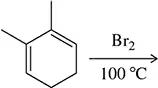
Predict the product of the following addition reactions to dienes.
(c) Chemical structure of a diene reacting with bromine at 100°C, illustrating an addition reaction.

Verified step by step guidance
1
Identify the structure of the diene provided in the image. The molecule is a conjugated diene with two double bonds in a six-membered ring, and it has methyl substituents attached to the ring.
Recognize the reagent and reaction conditions. Bromine (Br₂) is added to the diene under high-temperature conditions (100°C), which suggests a thermodynamic control mechanism.
Understand the reaction mechanism. Bromine reacts with conjugated dienes through an electrophilic addition mechanism. The high temperature favors the formation of the most stable product, which is determined by the stability of the carbocation intermediate and the final product.
Determine the regioselectivity of the addition. Bromine will add to the diene in a way that maximizes the stability of the intermediate and the final product. This typically involves forming the most substituted double bond in the product.
Predict the product. The reaction will result in the addition of bromine atoms to the conjugated diene, leading to a dibromo compound. The final product will have bromine atoms added across the double bonds, with the most stable configuration based on thermodynamic control.

Verified video answer for a similar problem:

This video solution was recommended by our tutors as helpful for the problem above.
Video duration:
4m
Was this helpful?

Key Concepts

Here are the essential concepts you must grasp in order to answer the question correctly.

Dienes

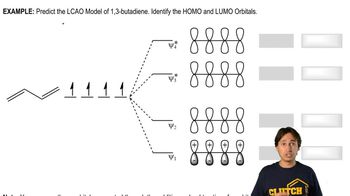
Dienes are organic compounds that contain two double bonds. They can be classified as conjugated, isolated, or cumulated based on the arrangement of the double bonds. Conjugated dienes, where double bonds are separated by a single bond, are particularly important in addition reactions due to their stability and reactivity, allowing for various electrophilic additions.
Recommended video:
Guided course
04:43
Drawing MO Diagram for Dienes

Electrophilic Addition Reactions

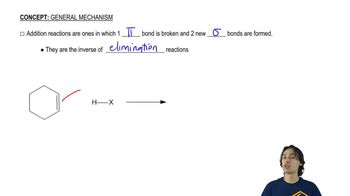
Electrophilic addition reactions involve the addition of an electrophile to a nucleophile, typically across a double bond. In the case of bromine (Br2) reacting with a diene, the double bond acts as a nucleophile, attacking the electrophilic bromine molecule. This reaction leads to the formation of a bromonium ion intermediate, which can then be attacked by a bromide ion, resulting in a dibrominated product.
Recommended video:
Guided course
05:39
Features of Addition Mechanisms.

Reaction Conditions

The conditions under which a reaction occurs can significantly influence the product formed. In this case, the reaction of bromine with the diene is conducted at 100°C, which can promote the formation of more stable products through increased kinetic energy. Higher temperatures can also favor elimination reactions or rearrangements, affecting the regioselectivity and stereochemistry of the final product.
Recommended video:
1:18
EAS Reactions of Pyridine Example 1