
Ch. 21 - Conjugated Systems I: Stability and Addition Reactions
Mullins - Organic Chemistry: A Learner Centered Approach 1st Edition
Mullins1st EditionOrganic Chemistry: A Learner Centered ApproachISBN: 9780137566471Not the one you use?Change textbook
Chapter 20, Problem 68

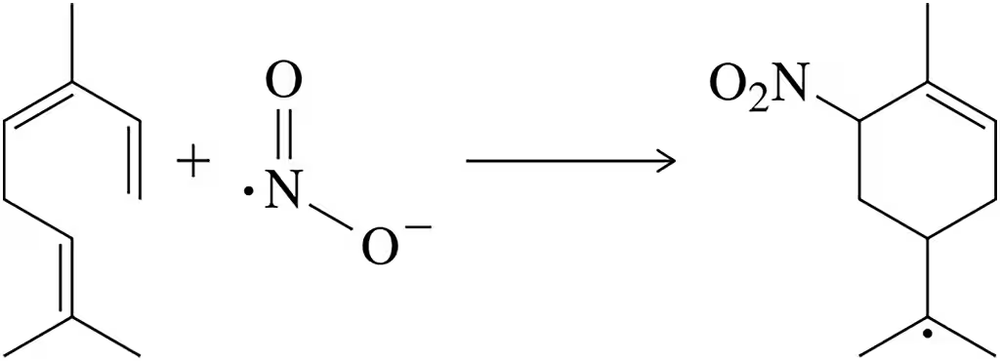
The following transformation was found to occur in areas with large NO₂ emissions. Suggest a mechanism for the reaction (J. Phys. Chem. 2013, 117, 14132–14140). [Hint: Use the fishhook arrows associated with radical reactions.]
Chemical reaction diagram showing a radical reaction with a benzene derivative and a nitro group.

Verified step by step guidance
1
Identify the reactants and products: The reactants are a diene and a nitrogen dioxide radical (NO₂•), and the product is a nitro-substituted aromatic compound with a radical on the alkyl group.
Recognize the type of reaction: This is a radical reaction, as indicated by the presence of the nitrogen dioxide radical and the hint to use fishhook arrows.
Initiate the radical mechanism: The nitrogen dioxide radical (NO₂•) can abstract a hydrogen atom from the alkyl group of the diene, generating a carbon-centered radical on the alkyl group.
Propagate the radical chain: The carbon-centered radical can then react with the nitrogen dioxide radical to form a new C-N bond, resulting in the nitro group being attached to the aromatic ring.
Terminate the radical mechanism: The remaining radical on the alkyl group can undergo further reactions, such as coupling with another radical or abstracting a hydrogen atom from a suitable donor, to stabilize the molecule.

Verified video answer for a similar problem:

This video solution was recommended by our tutors as helpful for the problem above.
Was this helpful?

Key Concepts

Here are the essential concepts you must grasp in order to answer the question correctly.

Radical Reactions

Radical reactions involve species with unpaired electrons, known as radicals. These reactions are typically characterized by their ability to initiate chain reactions, where one radical can generate more radicals. Understanding the behavior of radicals is crucial for predicting the outcome of reactions, especially in the context of environmental chemistry where pollutants like NO₂ can participate in radical mechanisms.
Recommended video:
Guided course
03:49
What are Radical Initiators?

Mechanism of Reactions

A reaction mechanism is a step-by-step description of how reactants transform into products. It outlines the sequence of elementary steps, including bond breaking and formation, and the intermediates involved. In the context of the question, proposing a mechanism requires identifying the key steps that radicals undergo when reacting with NO₂ emissions, which can help elucidate the overall transformation.
Recommended video:
Guided course
02:16
Heck Reaction Mechanism

Fishhook Arrows

Fishhook arrows are a notation used in organic chemistry to represent the movement of single electrons during radical reactions. Unlike regular arrows that indicate the movement of electron pairs, fishhook arrows show the formation and breaking of bonds involving radicals. Utilizing fishhook arrows is essential for accurately depicting the mechanism of the reaction suggested in the question, particularly in radical chain processes.
Recommended video:
Guided course
10:22
Common ways to move arrows in resonance.
Related Practice
Textbook Question

The following covalent inhibitor blocks function in a protease found in the porcine epidemic diarrhea virus by reacting with a cysteine amino acid residue (shown below) in the active site. Draw the expected complex that forms between the inhibitor and the enzyme active site (J. Med. Chem. 2017, 60, 3212–3216.) [Assume the presence of active site bases if you need them.]

<IMAGE>

2
views
Textbook Question

The reactivity of cyclopropanes often mimics that of alkenes.

(a) On the basis of this, suggest a mechanism for the following reaction.

2
views
Textbook Question

The reactivity of cyclopropanes often mimics that of alkenes.

(b) Besides opening the three-membered ring, what is the driving force for this reaction?

1
views
Textbook Question

The following reaction was used in the synthesis of aculeatin A, a natural product that is active against KB cell lines. Although it only worked under acidic conditions, a mechanism can be drawn where the reaction might proceed under basic conditions. Suggest this mechanism (J. Org. Chem. 2014, 79, 1498–1504). [The most acidic proton is indicated . . . and number your carbons!]

1
views
Textbook Question

In Chapter 9, electron-rich alkenes were oxidized under acidic conditions with mCPBA. Conjugated alkenes can be oxidized using the same reagent, but under basic conditions. Suggest a mechanism for this reaction. [Think about what is electron-rich and what is electron-poor in the reaction. Also, identify the bonds formed and broken.]


1
views