Ch. 2 - General Chemistry Translated: Finding the Electrons
Mullins - Organic Chemistry: A Learner Centered Approach 1st Edition
Mullins1st EditionOrganic Chemistry: A Learner Centered ApproachISBN: 9780137566471Not the one you use?Change textbook
Chapter 1, Problem 2a

Why do elements in the same group of the periodic table display similar reactivity?

Verified step by step guidance
1
Elements in the same group of the periodic table have the same number of valence electrons, which are the outermost electrons involved in chemical bonding.
The chemical reactivity of an element is largely determined by its ability to gain, lose, or share electrons to achieve a stable electron configuration, often resembling the nearest noble gas.
Since elements in the same group have identical valence electron configurations (e.g., Group 1 elements all have one valence electron), they tend to undergo similar types of chemical reactions.
For example, alkali metals (Group 1) all react with water to form hydroxides and hydrogen gas because they readily lose their single valence electron to form a +1 cation.
The periodic trends, such as atomic size and ionization energy, may vary down the group, but the fundamental similarity in valence electron configuration ensures comparable reactivity within the group.

Verified video answer for a similar problem:

This video solution was recommended by our tutors as helpful for the problem above.
Video duration:
3m
Was this helpful?

Key Concepts

Here are the essential concepts you must grasp in order to answer the question correctly.

Valence Electrons

Elements in the same group of the periodic table have the same number of valence electrons, which are the outermost electrons involved in chemical bonding. This similarity in valence electron configuration leads to comparable chemical properties and reactivity, as these electrons determine how an element interacts with others.
Recommended video:
Guided course
03:40
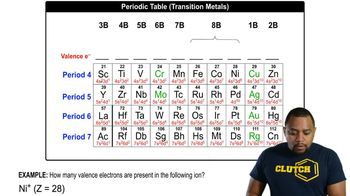
Valence Electrons of Transition Metals

Periodic Trends

Periodic trends refer to the predictable patterns observed in the properties of elements as you move across or down the periodic table. For instance, reactivity often increases down a group for metals and decreases for nonmetals, influenced by factors such as atomic size and electronegativity, which affect how easily an element can lose or gain electrons.
Recommended video:
Guided course
03:43
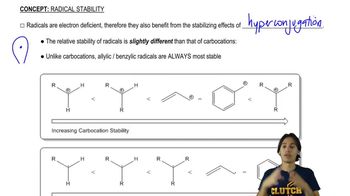
The radical stability trend.

Chemical Bonding

Chemical bonding is the process by which atoms combine to form molecules, primarily through the sharing or transfer of electrons. The type of bonding—ionic, covalent, or metallic—depends on the elements involved and their electron configurations, which are similar within a group, leading to analogous reactivity patterns among those elements.
Recommended video:
3:11
Chemical Reactions of Phosphate Anhydrides Concept 1